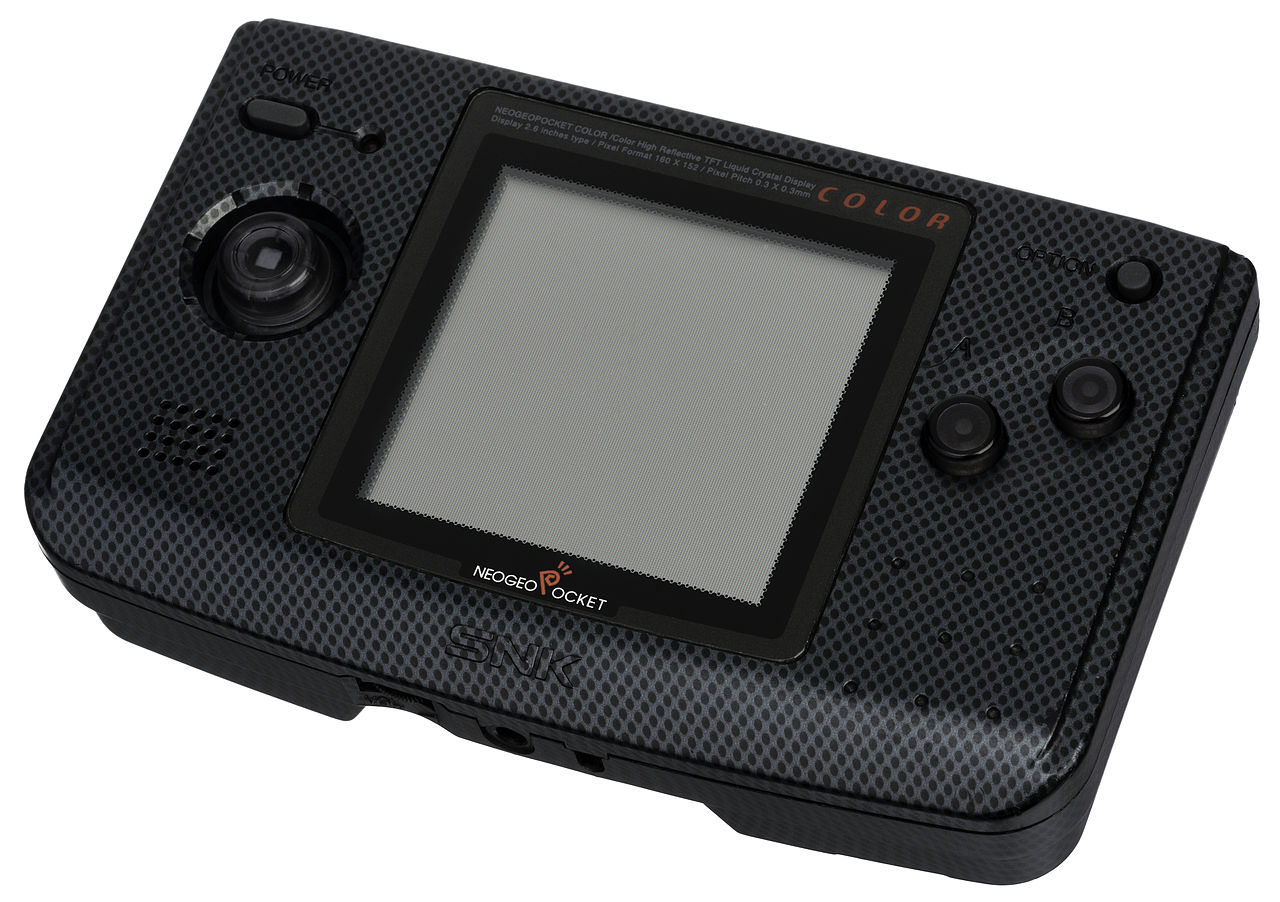
Neo Geo Pocket Color
- Manufacturer
- SNK
- Production
- 1999–2001
- Generation
- Gen 5
- Type
- Handheld
- Launch price
- $70
- Media
- Cartridge
About Neo Geo Pocket Color
The Neo Geo Pocket is a series of handheld game consoles developed and manufactured by Japanese video game company SNK between 1998 and 2001. The first model, the monochrome Neo Geo Pocket, was released in Japan in October 1998, marking SNK's entry into the handheld gaming market and competing with Nintendo's long-running Game Boy line. It was quickly superseded by the Neo Geo Pocket Color in 1999, a more widely produced model featuring a color display and full backward compatibility with the games for the original model.
Source: Wikipedia (text under CC BY-SA 4.0).
Library & collector facts
82licensed games
- North America: 31
- Japan: 82
- PAL: 39
What a Neo Geo Pocket Color costs right now
PriceCharting sold data · Verified 2026-08-07
Neo Geo Pocket Color (unspecified colour)
- Loose
- $104
- Complete in box
- $110
- Sealed / new
- —
Platinum Silver
- Loose
- $96
- Complete in box
- $275
- Sealed / new
- —
Ocean Blue
- Loose
- $109
- Complete in box
- $240
- Sealed / new
- $595
Anthracite
- Loose
- $121
- Complete in box
- $214
- Sealed / new
- —
Blue
- Loose
- $122
- Complete in box
- $160
- Sealed / new
- —
Stone Blue
- Loose
- $154
- Complete in box
- $220
- Sealed / new
- —
Crystal White (Japanese import colour)
- Loose
- $160
- Complete in box
- $180
- Sealed / new
- —
New Neo Geo Pocket Color — slim redesign, Japan only, Oct 1999 (Pearl Blue)
- Loose
- $116
- Complete in box
- $221
- Sealed / new
- $371
Accessories
| Item | Loose | CIB |
|---|---|---|
| AC adapter (3V DC, 1A, centre-POSITIVE — sold separately, never in the box) | $100 | $185 |
| Link cable (two consoles, two copies of the same game) | — | $49 |
| Wireless link adapter (Japan only — genuinely rare) | — | — |
| Dreamcast "DreamLink" cable (console-to-handheld) | — | — |
| Neck strap (official — listed in SNK's own accessory catalogue) | — | — |
| Carrying case (a free gift with the Sonic bundle bought direct from SNK) | — | — |
| Neo Geo Pocket Color + Sonic the Hedgehog bundle (retailed $99.95) | — | $265 |
| 4 Pack Expansion Game Set | $186 | — |
| NeoPocket GameDrive flashcart (modern) | $200 | $440 |
Two numbers decide almost every Neo Geo Pocket Color purchase. The first: a loose console runs about $100 and a boxed one two to three times that, so if you want to play rather than display, buy loose and spend the difference on games. The second: this is a $70 handheld from 1999 whose best games now cost more than the machine — Cotton, Evolution and Faselei! never crossed the Atlantic to America, and the eight Europe-only titles trade on a handful of sales a year, which is why their prices swing so violently. Two hardware notes that cost real money: the console runs on two AA batteries for roughly 40 hours, but the separate CR2032 coin cell backs up the clock AND the English/Japanese language setting — when it dies the machine reverts to Japanese, which is the single most common reason a working import 'arrives in the wrong language'. Game saves are held on the cartridge side as well, so a 26-year-old RPG cart can carry a dead save battery that no seller has thought to test.
SNK's own launch record, from its own press releases
No per-title sales figures survive for the Neo Geo Pocket Color the way they do for the Atari Jaguar, and SNK was a private Japanese company with no US filings, so there is no audited paper trail to mine. What does survive is better than the usual secondary retelling: SNK Corporation of America's own press releases and FAQ, published on snkusa.com in 1999 and preserved by the Internet Archive. The dates and figures below are SNK's, in SNK's words.
Two things in this record contradict what is usually written about the platform. SNK sold the console online for a couple of months BEFORE any retail launch, which is why release dates for this system disagree across databases. And SNK's own two press releases, issued fifteen days apart, disagree with each other about how many games would be on shelves on day one.
| Date | What SNK said | Source |
|---|---|---|
| 25 November 1998 | The monochrome Neo Geo Pocket wins a 1998 Good Design Award from the Japan Industrial Design Association, in the Sports and Leisure category | SNK's own news page |
| Summer 1999 | Console sold online only, direct from snkusa.com and eToys | Press release, 21 July 1999 |
| 21 July 1999 | Retail launch announced for 6 August at $69.95, with twelve titles at $24.95–$34.95 | Press release, 21 July 1999 |
| 6 August 1999 | Retail debut nationwide at $69.95, in six casing colours, with six titles | Press release, 6 August 1999 |
| 6 August 1999 | Eleven titles promised by end of August; "more than 20" before year end | Press release, 6 August 1999 |
| 31 August 1999 | Pac-Man released, licensed to SNK from Namco | Press release, 6 August 1999 |
| 1999 (FAQ) | Six console colours at launch; twelve titles expected; no backlit screen; retail distribution "planned for the fall" | snkusa.com NGPC FAQ |
| 1999 (spec) | A custom reflective TFT screen measuring 45 x 48 mm, 146 colours on screen from a 4,096 palette, and a built-in Pocket Menu, calendar, alarm, world clock and horoscope | SNK Japan's English spec page |
| End of 1999 | Over 25,000 units sold in Japan; about 25,000 in the US in its first two months; more than 100,000 in Europe | Cited figures, Wikipedia |
| February 2000 | "What's that new portable system that's causing quite a stir?" — EGM adds a dedicated Neo Geo Pocket Color section | EGM #127, editor's letter |
| January 2000 | Aruze, a pachinko and casino-machine maker, buys a controlling interest in SNK | EGM #134 timeline |
| May 2000 | At E3, four or five major US third parties were reportedly preparing NGPC games; SNK had just signed a five-year lease on a new Torrance facility | EGM #134, source inside SNK |
| 13 June 2000 | SNK withdraws from the North American market. "This decision came as a sucker punch. No one expected this." — Ben Herman, VP of sales, SNK Entertainment USA | EGM #134 |
| 13 June 2000 | SNK asks retailers to return ALL unsold hardware and software immediately, for full reimbursement | EGM #134, quoting SNK's press release |
| By 20 July 2000 | snkusa.com reduced to an empty directory listing — the entire US site gone | Internet Archive capture |
| Mid-2000 | Roughly a 2% share of the American handheld market; approximately 200,000 Neo Geo Pocket Colors sold in America over its whole US life | EGM #134, citing TRST retail tracking |
| Mid-2000 (cancelled) | Sequels to Match of the Millennium and Card Fighters' Clash were in development, plus an MP3 player accessory; only Card Fighters 2 ever shipped, in Japan | EGM #134 gossip column |
| 21 October 1999 | The "New Neo Geo Pocket Color" — 13% smaller, better sound — is released in Japan only. Every slim unit in the West is an import | Wikipedia |
| September 2000 | Collectors strip US retailers of remaining stock ahead of the recall — "gamers everywhere ran at a rabid pace to clean out U.S. retailers of their NGP stock before SNK could do it" | GameFan vol. 8 no. 9, editor's column |
| November 2000 | Five months after the withdrawal, EGM notes NGPC games already fetch "astronomically high prices on eBay" | EGM #136 |
| 13 September 2001 | SNK vs. Capcom: Card Fighters 2 Expand Edition — the last release, Japan only | Wikipedia release table |
| 30 October 2001 | SNK declared bankruptcy, ending the platform | Cited figure, Wikipedia |
- The hardware price was $69.95 and games were $24.95–$34.95 — SNK's figures, not an estimate. Our own console record rounded this to $69.
- The six North American launch colours were Blue, Platinum Silver, Anthracite, Ocean Blue, Stone Blue and Clear. Our own record previously listed Crystal White, which SNK did not name at launch, and omitted Blue and Ocean Blue.
- SNK's 21 July release names eight titles shipping on 6 August and twelve in total; its 6 August release says six shipped that day and eleven would be out by month end. The company changed its own story inside a fortnight, which is a fair summary of how the launch went.
- The claimed battery life was "nearly 40 hours" on two AAs, explicitly pitched as double the Game Boy Color's. The console also had an alarm, a calendar, a six-city world clock and a horoscope.
- SNK described the control as a "unique revolving joystick" — the microswitched stick that is still the main reason this handheld is remembered. The design was recognised at the time: the monochrome Neo Geo Pocket took a 1998 Good Design Award from the Japan Industrial Design Association in the Sports and Leisure category. SNK's own site describes that award two different ways on two different pages, which is a small thing but a familiar pattern here — the company was not careful with its own record.
- A cause of death nobody lists, from someone who covered it at the time: SNK gave magazines no practical way to capture screenshots. GameFan's editor put "no means to capture screens for consumer magazines" alongside poor marketing ("TV commercials at 3 A.M. on UHF?!"), absent third-party support and the Game Boy's grip as the reasons it died. The hardware has no video out at all, which is still why footage of these games is scarce — a handheld that cannot be photographed cannot be reviewed properly, and a handheld that is not reviewed does not sell.
- The recall has a second half that explains why any American stock survives. SNK asked retailers to send back everything unsold — but collectors got there first. GameFan's September 2000 column describes gamers who "ran at a rabid pace to clean out U.S. retailers of their NGP stock before SNK could do it", already reselling on eBay "for twice the money". The collector market for this platform did not build slowly over decades; it formed within weeks of the announcement, and it formed out of stock that was supposed to go back to the manufacturer.
- The retail warranty was 180 days on hardware and hardware accessories, with proof of purchase required. That is worth knowing alongside the June 2000 recall: when SNK pulled out it told owners still inside that window to call 1-877-PLAY-SNK for exchanges, so some surviving consoles are warranty replacements rather than original purchases.
- The most telling artefact is the web server. In October 1999 snkusa.com was a full product site with press releases, an FAQ, an owners' section and an order form. By 20 July 2000 the whole thing had been deleted down to a bare Apache directory index containing one empty temporary file, and it stayed that way through 2001. Aruze ceased SNK's North American and European operations on 13 June 2000 — so the deletion lands about five weeks later, which is an independent physical trace of a date normally cited from secondary sources alone.
- On the question of how many were sold: we removed the 2,000,000 figure our own console record used to carry, rather than replace it with another guess. It is widely repeated and we could not source it. The best American number we have found is contemporaneous — EGM reported in September 2000 that "approximately 200,000 Neo•Geo Pocket Colors were sold in America since its release late last summer." Add the cited regional figures (over 25,000 in Japan and more than 100,000 in Europe by the end of 1999) and a 2% share of the US handheld market, and two million is not a number this platform ever reached in the West.
- The most useful fact for a collector is one nobody repeats: THE US STOCK WAS RECALLED. Quoting SNK's own press release, EGM reported that the company "had requested retailers return all unsold hardware and software immediately for full reimbursement" — and that SNK planned to repackage the returns and sell them in Japan, because "the flash ROM cartridges can be easily rewritten with other games and the guts of the unit refit into the smaller Japanese model's casing." That is the explanation for two things people find strange about this platform: why sealed North American stock is so thin on the ground, and why a genuine SNK cartridge is not automatically the game its label claims. It also means some Japanese-cased consoles may contain American internals — by the manufacturer's own design, not a modder's.
- One last thing our own data corroborates. EGM reported that a chunk of SNK's internal development staff walked after Aruze — a pachinko and casino-machine maker — took control, reportedly on being told to make pachinko titles instead of fighting games; SNK's Japanese office denied any "whole team departures" on the record. Look at what the platform actually released afterwards. Eight of the 73 Color games are Aruze PachiSlot Kingdom machine simulators, and every one of them is dated 2000 or 2001. The library itself records the change of ownership.
Built from two period sources rather than from later retellings. First, SNK Corporation of America's own press releases (21 July and 6 August 1999), its Neo Geo Pocket Color FAQ, and its hardware and order pages, all recovered from snkusa.com through the Internet Archive's Wayback Machine. Second, Electronic Gaming Monthly — the withdrawal reporting, the 200,000-unit US figure, the recall and the Ben Herman quotes are from "SNK USA RIP" by Chris Johnston, Mark MacDonald and Sam Kennedy in issue #134 (September 2000); the launch-era commentary is from issue #127 (February 2000) and the eBay-prices note from issue #136 (November 2000). GameFan volume 8 issue 9 (September 2000) supplies the shelf-clearing account, the screenshot-capture problem and the English Faselei! ROM; its volume 7 issue 8 (August 1999) carries SNK's own launch advertising. All scanned at the Internet Archive. SNK's Japanese site (neogeo.co.jp) carried an English technical page, which is where the screen dimensions, the 'simulated color' behaviour of monochrome cartridges on a Color, and the built-in Pocket Menu come from. Library counts and regional release data are re-derived from the tables in Wikipedia's List of Neo Geo Pocket games. Prices are PriceCharting sold data, pulled from its console list endpoint on 7 August 2026 — Electronic Gaming Monthly #134 (September 2000)
The coin cell, the stick and the battery bay — inspect before you buy
The Neo Geo Pocket Color has an unusually good survival record for a 1999 handheld — the screen does not rot the way a Game Gear's does, and the shell is famously solid. Its failure modes are narrower and more specific than that reputation suggests, and two of them are invisible in photographs. Test for those two first; everything else on this list you can see.
What failure looks like
- The console boots into Japanese, or asks you to set the clock every single time it powers on. That is a dead CR2032 coin cell, not a Japanese import — the cell backs up the clock and the English/Japanese language setting.
- A direction on the stick needs a hard push, registers twice, or sticks. The Neo Geo Pocket Color uses a clicking microswitched stick rather than a rubber membrane, and worn switches are the platform's most common control fault.
- Green or white crust in the AA battery bay, or a console that runs on a mains adapter but not on batteries — corroded or broken battery contacts, which is the single most common cause of a "dead" unit.
- Vertical or horizontal lines across the LCD, or dead pixels. Unlike the Virtual Boy's solder-joint fault this is not usually repairable — it is a failed panel.
- A save file that vanishes between sessions on an RPG. Neo Geo Pocket cartridges carry their own save batteries, so this is usually the cartridge rather than the console — test the same cartridge in another machine before condemning either.
- The screen looks dim or unreadable indoors. That is not a fault: the original display has no backlight at all, by design.
How to test before you buy
- You do not need a cartridge to test one. SNK built a Pocket Menu into the console along with a calendar, an alarm, an international clock and a horoscope, so a seller has no excuse for "untested, no games to try it with" — this is the exact opposite of an Atari Lynx, which will not power on at all without a cartridge inserted.
- Power on and look at the clock/language screen. If the machine has kept the time and comes up in English, the coin cell is alive — that one observation is worth more than any photo of the shell.
- In the system menu, switch the language between English and Japanese, power the console fully off, and power it back on. If the setting held, the cell is genuinely good rather than just freshly replaced minutes ago.
- Run all eight directions on the stick and listen. You want a clean, even click on each one. A mushy or silent direction is a worn microswitch.
- Open the battery door and photograph the contacts. Ask for that photo specifically — sellers routinely photograph the front of the console and never the bay where the damage is.
- Ask the seller to run the console on fresh AA batteries rather than the adapter. A unit that only runs on mains has broken contacts or a broken bay.
- View the screen off-axis in bright light and look for lines and dead pixels. Do not accept a photo taken with the screen off — a dark LCD hides everything.
- For any cartridge with a save (the RPGs, Dive Alert, Faselei!, Evolution, Biomotor Unitron, Ogre Battle Gaiden), ask whether a save survives a power cycle. A dead cartridge battery is invisible until you try.
Listing language that quietly means "this needs work"
The two common faults are both cheap. A CR2032 coin cell is a couple of dollars and the swap needs a tri-wing screwdriver and about ten minutes — it restores the clock and, more usefully, makes the English language setting stick. Corroded battery contacts are a similar order of cost if you can solder, and replacement contacts are readily available. A failed LCD panel is the one to walk away from: donor screens cost more than most working consoles, and modern IPS replacement kits exist but are a real modification, not a repair. Price a "dead" unit as a parts machine unless the seller has confirmed the fault is the battery bay.
If you are selling one, the two photographs that raise your price most are the battery bay with the door open, and the console powered on showing the clock screen in English. Between them they answer the only two questions an informed buyer has. State whether the coin cell has been replaced and when, and for any RPG cartridge say whether a save survives a power cycle — that single line separates your listing from the "untested" pile.
How selling works →What "complete" means on a Neo Geo Pocket Color
The retail box contained
- The cartridge, in its moulded SNK shell.
- The printed manual, in the language of the release region.
- The box or case — a card box for the Japanese and North American releases, and a plastic clamshell case for most of the European ones. Faselei! in particular is a UK clamshell release; a Faselei! sitting in a card box deserves a question.
- The inner tray or card insert that holds the cartridge in position.
- Any per-game pack-in. The one that catches people out is Pac-Man, which shipped with a Four-Way CrossRing — a small plastic ring that sits over the stick to restrict it to four directions — in a plastic bag tucked under the cartridge. SNK's own catalogue listed the game as "PAC MAN … W/ 4 WAY ADAPTER", so this is not folklore: a Pac-Man described as complete without it is not complete.
- For consoles: two AA batteries, a CR2032 lithium backup cell, and the manual — all three were in the retail box, per SNK's own launch materials. SNK's catalogue also lists a neck strap among its four official accessories, so a genuinely complete console box should have one.
- Region note for anything that looks wrong: SNK ran distribution arms well beyond the three usual territories — Neo Geo do Brasil in São Paulo, plus offices in Hong Kong, Singapore, London and Dubai. A Brazilian-market blister pack is a real SNK product and not evidence of a fake, even though it matches no North American, European or Japanese packaging.
The AC adapter was NOT in the retail console box — SNK sold it separately, and it now runs about $100 loose on its own. So a console listed as "complete with adapter" is a console plus an extra, not a more complete box; conversely a boxed console without an adapter is not missing anything. If you do buy one, the official spec is 3V DC at 1A, centre-POSITIVE; the original supplies are unregulated, so measured output drifts around 3V under load. The link cable was likewise a separate purchase, and per SNK's own FAQ it only ever worked between two copies of the same game, so a link cable is not "missing" from any single game's box.
Grading shorthand
- Loose
- Cartridge only. On this platform that is typically 20–35% of the complete price, which is a far steeper discount than most handhelds.
- Complete (CIB)
- Cartridge, manual, insert and box or clamshell, all matching the same region. Mixed-region CIB — a Japanese cart in a US box — should be described as such and priced as loose plus packaging.
- Sealed
- Factory sealed. Two cautions. Most published "new" figures for Neo Geo Pocket games are calculated rather than observed, so treat quoted sealed prices sceptically. And sealed North American stock is genuinely scarce for a documented reason — SNK recalled all unsold US hardware and software in June 2000 for full reimbursement, then planned to repackage it for Japan.
- Console, working
- Powers on, holds the clock and language setting through a power cycle, clean battery contacts, all eight stick directions clicking, no lines on the panel.
The complete library — all 82 cartridges that run on a Neo Geo Pocket Color
prices PriceCharting · Verified 2026-08-07
The English library (39) — 31 released in North America, plus 8 only in Europe
| Game | Loose | CIB | Sealed | Availability | Fake risk |
|---|---|---|---|---|---|
| Evolution: Eternal Dungeons2000 | $1,155 | $1,519 | — | Cartridge only | High |
| Fantastic Night Dreams: Cotton2000 | $895 | $1,445 | — | Cartridge only | High |
| Faselei!1999 | $206 | $517 | — | Cartridge only | High |
| Magical Drop Pocket1999 | $182 | $295 | — | Cartridge only | High |
| SNK Gals' Fighters2000 | $130 | $344 | — | NGPC Selection 1 | High |
| Biomotor Unitron1999 | $111 | $155 | $300 | NGPC Selection 2 | High |
| The Last Blade: Beyond the Destiny2000 | $109 | $490 | — | NGPC Selection 1 | High |
| Puyo Pop1999 | $107 | $240 | — | Cartridge only | High |
| Shanghai Mini2000 | $103 | $184 | — | Cartridge only | High |
| Neo Dragon's Wild1999 | $97 | $299 | $398 | Cartridge only | High |
| Metal Slug 2nd Mission2000 | $85 | $215 | $348 | NGPC Selection 1 | High |
| Neo 212000 | $85 | $300 | $400 | Cartridge only | High |
| Pocket Reversi2000 | $85 | — | — | Cartridge only | Med |
| Dive Alert: Becky's Version2000 | $80 | $220 | $399 | Cartridge only | High |
| Dynamite Slugger2000 | $78 | $608 | — | Cartridge only | High |
| Crush Roller1999 | $75 | $170 | $313 | Cartridge only | High |
| Neo Cherry Master Color1999 | $75 | $75 | — | Cartridge only | Med |
| Neo Mystery Bonus1999 | $75 | $272 | $290 | Cartridge only | High |
| Picture Puzzle2000 | $55 | $809 | — | Cartridge only | High |
| Pocket Tennis Color1999 | $55 | $140 | — | NGPC Selection 2 | Med |
| Dive Alert: Matt's Version2000 | $51 | $168 | $248 | Cartridge only | High |
| SNK vs. Capcom: Match of the Millennium1999 | $48 | $86 | $172 | NGPC Selection 1 | Med |
| SNK vs. Capcom: Card Fighters' Clash - Capcom Version1999 | $47 | $130 | — | Cartridge only | Med |
| Sonic the Hedgehog Pocket Adventure1999 | $47 | $200 | $290 | Cartridge only | High |
| Baseball Stars Color1999 | $46 | $80 | — | NGPC Selection 2 | Med |
| Puzzle Link 22000 | $46 | $185 | — | NGPC Selection 2 | High |
| SNK vs. Capcom: Card Fighters' Clash - SNK Version1999 | $43 | $160 | $257 | NGPC Selection 2 | High |
| Dark Arms: Beast Buster1999 | $41 | $170 | — | NGPC Selection 1 | High |
| Metal Slug 1st Mission1999 | $40 | $101 | $155 | NGPC Selection 1 | Med |
| Neo Turf Masters1999 | $39 | $158 | — | NGPC Selection 1 | High |
| Neo Geo Cup '98 Plus Color1999 | $37 | $50 | $132 | NGPC Selection 2 | Low |
| Bust-a-Move Pocket1999 | $36 | $79 | — | Cartridge only | Med |
| Neo Baccarat2000 | $35 | $83 | — | Cartridge only | Med |
| Samurai Shodown! 21999 | $32 | $160 | $435 | NGPC Selection 1 | High |
| Fatal Fury: First Contact1999 | $25 | $94 | $143 | NGPC Selection 1 | Med |
| Puzzle Link1999 | $25 | $135 | $277 | Cartridge only | Med |
| King of Fighters R-21999 | $21 | $68 | $100 | NGPC Selection 1 | Med |
| Pac-Man1999 | $16 | $64 | $121 | Cartridge only | Med |
| Cool Boarders Pocket2000 | — | $458 | — | Cartridge only | High |
Japan-only Neo Geo Pocket Color releases (34)
| Game | Loose | CIB | Sealed | Availability | Fake risk |
|---|---|---|---|---|---|
| Nige-ron-pa2000 | $456 | $583 | — | Cartridge only | Med |
| Mizuki Shigeru Yōkai Shashinkan1999 | $400 | $880 | $1,800 | Cartridge only | Med |
| Rockman Battle & Fighters2000 | $156 | $336 | — | NGPC Selection 2 | Med |
| Delta Warp2000 | $148 | $159 | — | Cartridge only | Low |
| Big Bang Pro Wrestling2000 | $140 | $494 | — | NGPC Selection 2 | Med |
| Infinity Cure2000 | $136 | $299 | $611 | Cartridge only | Med |
| Ganbare Neo Poke-Kun2000 | $91 | $125 | — | NGPC Selection 2 | Low |
| Super Real Mahjong Premium Collection2001 | $80 | $130 | — | Cartridge only | Low |
| PachiSlot Aruze Kingdom - Porcano 22000 | $77 | $1,000 | — | Cartridge only | Med |
| Pocket Love: If1999 | $66 | $66 | $133 | Cartridge only | Low |
| Party Mail1999 | $65 | $130 | — | Cartridge only | Low |
| Memories Off Pure2000 | $50 | $109 | — | Cartridge only | Low |
| PachiSlot Aruze Kingdom - e-CUP2001 | $49 | $108 | $221 | Cartridge only | Low |
| The King of Fighters: Battle de Paradise2000 | $42 | $81 | — | NGPC Selection 2 | Low |
| Cool Cool Jam2000 | $40 | $65 | $280 | Cartridge only | Low |
| Ogre Battle Gaiden: Prince of Zenobia2000 | $34 | $50 | $129 | Cartridge only | Low |
| Densha de Go! 21999 | $32 | $47 | $113 | Cartridge only | Low |
| Neo Derby Champ Dayosō1999 | $30 | $56 | — | Cartridge only | Low |
| Kikou Seiki Unitron2000 | $24 | $54 | $108 | Cartridge only | Low |
| SNK vs. Capcom: Card Fighters 2 Expand Edition2001 | $20 | $224 | — | Cartridge only | Med |
| PachiSlot Aruze Kingdom - Ward of Lights2000 | $18 | $58 | — | Cartridge only | Low |
| PachiSlot Aruze Kingdom - Ōhanabi2000 | $11 | $99 | — | Cartridge only | Low |
| Master of Syougi Color1999 | $9 | $20 | $40 | Cartridge only | Low |
| PachiSlot Aruze Kingdom - Del Sol 22000 | $8 | $21 | $42 | Cartridge only | Low |
| Mezase! Kanji-Ō2000 | $6 | $14 | — | Cartridge only | Low |
| Neo Poke Pro Yakyū1999 | $5 | $60 | — | Cartridge only | Low |
| Bikkuriman 2000 Viva! Pocket Festival2000 | — | — | — | Cartridge only | Low |
| Doko Demo Mahjong1999 | — | — | — | Cartridge only | Low |
| Koi Koi Mahjong2000 | — | — | — | Cartridge only | Low |
| PachiSlot Aruze Kingdom - Azteca2000 | — | — | — | Cartridge only | Low |
| PachiSlot Aruze Kingdom - Dekahel2001 | — | — | — | Cartridge only | Low |
| PachiSlot Aruze Kingdom - Hanabi1999 | — | — | — | Cartridge only | Low |
| Pachinko Hisshō Guide: Pocket Parlor1999 | — | — | — | Cartridge only | Low |
| Soreike! Hanafuda Dōjō1999 | — | — | — | Cartridge only | Low |
The monochrome Neo Geo Pocket library (9) — Japan, 1998; all nine run on a Color
| Game | Loose | CIB | Sealed | Availability | Fake risk |
|---|---|---|---|---|---|
| Samurai Shodown!1998 | $66 | $87 | $360 | Cartridge only | Low |
| King of Fighters R-11998 | $53 | $69 | — | Cartridge only | Low |
| Pocket Tennis1998 | $46 | $98 | — | Cartridge only | Low |
| Neo Geo Cup '98 Plus1998 | $34 | $50 | — | Cartridge only | Low |
| Baseball Stars1998 | — | $34 | — | Cartridge only | Low |
| Master of Syougi1998 | — | — | — | Cartridge only | Low |
| Melon-chan's Growth Diary1998 | — | $55 | — | Cartridge only | Low |
| Neo Cherry Master1998 | — | — | — | Cartridge only | Low |
| Puzzle Link1998 | — | — | — | Cartridge only | Low |
Reproductions, relabelled imports and reprinted boxes
This platform gives a forger three separate openings, and it is worth being clear about which is which. First, straightforward reproduction cartridges: the expensive English fighters are small games on cheap flash hardware, and repro shells with printed labels circulate freely. Second — and specific to the Neo Geo Pocket Color — relabelled Japanese cartridges. The hardware is region-free and the console holds the language setting, so a Japanese cart with an English label will boot, run and look right to someone who does not know what the real label looks like. Third, the reprinted box and insert. That last one is where the most money changes hands, because on this platform the packaging is routinely worth more than the cartridge.
| Game | Loose cart | Complete in box | What the packaging is worth |
|---|---|---|---|
| The Last Blade: Beyond the Destiny | $109 | $490 | +$381 |
| Fantastic Night Dreams: Cotton (Europe) | $895 | $1,445 | +$550 |
| Faselei! (Europe) | $206 | $517 | +$311 |
| SNK Gals' Fighters | $130 | $344 | +$214 |
| Neo 21 | $85 | $300 | +$215 |
| Sonic the Hedgehog Pocket Adventure | $47 | $200 | +$153 |
| Dark Arms: Beast Buster | $41 | $170 | +$129 |
| SNK vs. Capcom: Card Fighters' Clash (SNK Version) | $43 | $160 | +$117 |
What actually distinguishes them
- Read the label edge, not the artwork
- Genuine SNK labels are printed, not inkjetted, and the ink runs cleanly to a crisply cut edge. Reproductions are usually printed on adhesive photo stock and cut by hand: look for a visible white paper edge, a slightly glossy surface, dot patterns visible under a phone macro shot, and artwork that sits a millimetre off-centre in the label recess. Ask for a straight-on macro of the label corner — this single photo settles most cases.
- The label recess should be filled, and flush
- SNK cartridge shells have a moulded recess sized for the label. A genuine label sits inside it and finishes flush with the surrounding plastic. A reproduction applied over an existing cartridge sits proud of the recess, or leaves a visible gap around the edge where the new label is fractionally smaller than the well.
- Check the language the game actually boots in
- This is the relabelled-import test, and it is the one most specific to this console. Set the console's language to English, then boot the cartridge. A genuine English release is in English. A Japanese cartridge wearing an English label will still show Japanese text in-game on most titles, because the language setting governs the system menu and only the games that shipped bilingual respond to it. If the seller cannot show you the in-game title screen, treat the label as unverified.
- Look for a moulded SNK marking on the shell
- Genuine shells carry crisp moulded text and part markings from the injection tool. Reproduction shells are usually cast or sourced blank, so the text is soft, shallow, absent, or sanded away. Sanding marks on the back of a cartridge are a strong signal that a label was removed from a donor cart.
- Weigh the reprinted insert against the cardboard
- Because a box and manual can be worth more than the cartridge — over $380 on The Last Blade, $215 on Neo 21 — reprinted inserts and boxes are the most profitable fake on this platform and the least likely to be disclosed. Genuine manuals show 1999–2000 print wear, a slight yellowing on the paper stock, and staples that have sat in the same holes for 25 years. A bright white manual with sharp corners inside an otherwise worn box is the mismatch to look for.
- Know which body you are looking at — and why the slim one matters
- There are two Neo Geo Pocket Color bodies, and only one was sold in the West. The original, from August 1999, measures about 130 x 80 x 30 mm and weighs around 145 g. The "New Neo Geo Pocket Color" — a 13% smaller redesign with improved sound output — was released on 21 October 1999 in JAPAN ONLY, at roughly 126 x 74 x 30 mm and 120 g without batteries. So any slim unit offered in North America or Europe is an import, however it is described. That matters here rather than in a spec table for one reason: the slim shell is precisely what SNK said it would put recalled American hardware into. When it withdrew from the US it took back retailers' unsold stock and told the press it would refit "the guts of the unit into the smaller Japanese model's casing". A slim console is therefore the one body where an American mainboard in a Japanese shell is the manufacturer's own doing rather than a red flag.
- The cartridges are flash ROM — and SNK itself planned to rewrite them
- This is the tell nobody writes about, and it comes from SNK's own withdrawal. When the company pulled out of North America on 13 June 2000 it asked retailers to return all unsold hardware and software for full reimbursement, and told the press it would repackage the returns for Japan because — in EGM's words — "the flash ROM cartridges can be easily rewritten with other games and the guts of the unit refit into the smaller Japanese model's casing". So on this platform a genuine SNK cartridge is not automatically the game on its label, and a Japanese-cased console may hold American internals, by the manufacturer's design rather than a modder's. Practically: boot the cartridge and check the title screen against the label, always, even when the shell and label both look perfect. It is also why sealed North American stock is far thinner than a one-year retail run would suggest.
- Fake flashcarts are a separate problem
- The modern NeoPocket GameDrive / Flash Masta flashcarts are themselves cloned. Flash Masta publish their own guide to spotting the clones: the counterfeits copy the board traces but use different switches, different flash chips and different silkscreen text. If you are buying a flashcart rather than a game, buy it from the maker.
None of this makes reproductions illegitimate. Thirty-four of the 73 Color games never left Japan and eight more never reached North America, so for a large part of this library a reproduction or a flashcart is the only practical way to play in English at all — and the Switch collections cover only twenty titles. The problem is never that a reproduction exists. It is a reproduction sold without saying so, at a genuine cartridge's price. Sellers who label repros as repros are doing the platform a favour; the ones who photograph a repro cart next to a genuine box are not.
Link play — what the cable actually does, game by game
Link play is the reason a lot of people bought this handheld, and it is also the thing most often described wrongly. The rule is strict and it comes from SNK: the link works between two copies of the exact same game, and not every game supports it. There is no equivalent of the Game Boy Advance's single-cartridge multiplayer here — you need two consoles, two cartridges of the same title, and one cable.
What the link does varies far more than a simple yes/no suggests. Some games give you a straight versus match. Some only let you trade items and have no battle mode at all. A handful talk to a Dreamcast game instead of to another handheld. And a small group of Japanese releases work with a wireless adapter almost nobody has seen.
A word on how this list was built, because link-play lists for old handhelds are usually somebody's memory. Two sources sit behind it. SNK's own October 1999 software page published a per-game LINK column — including five games it marked as having none, which is rarer and more useful than a list of yeses. That table only covers the 1999 line-up, so the rest comes from a modern hands-on compilation that describes what the link does in each game. The two agree on all eighteen titles they both cover, including all five of the negatives, which is why the later entries are listed here as fact rather than quarantined as hearsay.
- What you need
- 2 + 2 + 1
- Link cable
- 2 systems
- Wireless link
- 64 systems
- Dreamcast link
- 1 + 1
Two consoles, two copies of the same game, one cable. Confirmed in SNK's own 1999 FAQ.
The standard accessory, sold separately — never included with a game.
SNK's own 1999 accessory table lists a wireless link at 64 units, marked "SOON". It reached Japan in tiny numbers and only a few games use it.
SNK's "DreamLink" cable, joining a Neo Geo Pocket Color to a Dreamcast game.
Head-to-head over the link cable(47)
A genuine versus mode against a second player. Where a monochrome and a Color version both exist, both support it.
- SNK vs. Capcom: Match of the Millennium(also links to Card Fighters' Clash to unlock content)
- SNK vs. Capcom: Card Fighters' Clash (SNK)(card battles and trading)
- SNK vs. Capcom: Card Fighters' Clash (Capcom)(card battles and trading)
- SNK vs. Capcom: Card Fighters 2 Expand Edition
- King of Fighters R-2(fights, plus trading skills from MAKING mode)
- King of Fighters R-1(monochrome)
- The Last Blade: Beyond the Destiny(fights, trades scrolls, and unlocks a minigame)
- SNK Gals' Fighters(fights and trades items)
- Samurai Shodown! 2(fights, and trades up to 8 cards at a time)
- Samurai Shodown!(monochrome)
- Fatal Fury: First Contact
- Big Bang Pro Wrestling
- Faselei!(mech-vs-mech from the base menu)
- Sonic the Hedgehog Pocket Adventure(Duel Room — race or coin race; player 2 is Tails)
- Dark Arms: Beast Buster(battle with the weapons you grew)
- Neo Turf Masters(stroke and match play, and club swapping)
- Magical Drop Pocket
- Puyo Pop
- Bust-a-Move Pocket(linking turns VS CPU into VS Human)
- Crush Roller(stages must be cleared in single player first)
- Puzzle Link
- Puzzle Link (monochrome)
- Puzzle Link 2(also battles cards earned in the single-player Card mode)
- Shanghai Mini(a race to clear, with special animal tiles)
- Delta Warp(compete AND swap puzzles built in the editor)
- Picture Puzzle(a race to finish the picross grid)
- Pocket Reversi(link only — there is no hot-seat option)
- Pocket Tennis Color(singles only, no doubles)
- Pocket Tennis (monochrome)
- Neo Geo Cup '98 Plus Color(winning raises team popularity; items tradable in the Soccer Shop)
- Neo Geo Cup '98 Plus (monochrome)
- Baseball Stars Color(the winner may recruit a player from the loser)
- Baseball Stars (monochrome)
- Dynamite Slugger(adjustable rules before the match)
- Kikou Seiki Unitron(trades AND battles, unlike the first game)
- Ogre Battle Gaiden: Prince of Zenobia(squad vs squad)
- Nige-ron-pa(team vs team)
- Mizuki Shigeru Yōkai Shashinkan(the cards you photograph fight each other)
- Neo 21(player 1 deals, player 2 bets — not both against the house)
- Neo Derby Champ Dayosō
- Doko Demo Mahjong
- Koi Koi Mahjong
- Master of Syougi Color
- Master of Syougi (monochrome)
- Mezase! Kanji-Ō(a kanji quiz, head to head)
- Cool Cool Jam
- Bikkuriman 2000 Viva! Pocket Festival(trade stickers and compete via the wishing well)
Trading only — no versus mode at all(3)
The link works, but there is nothing to fight over. Worth knowing before you buy a second copy and a cable expecting a match.
Also links to a Dreamcast game(6)
Cross-device play over SNK's "DreamLink" cable — the platform's headline gimmick, and the reason several of these cartridges are more interesting than they look. These titles also appear above.
- King of Fighters R-2(↔ King of Fighters: Dream Match '99)
- SNK vs. Capcom: Match of the Millennium(↔ King of Fighters: Dream Match '99)
- SNK vs. Capcom: Card Fighters 2 Expand Edition(↔ Capcom vs. SNK 2, after finishing the campaign)
- The King of Fighters: Battle de Paradise(↔ King of Fighters '99 Evolution)
- Cool Cool Jam(↔ Cool Cool Toon)
- Bikkuriman 2000 Viva! Pocket Festival(↔ its Dreamcast counterpart)
Works with the Japan-only wireless adapter(4)
SNK advertised a wireless link for up to 64 systems in 1999 and it never shipped at that scale. A wireless adapter did reach Japan in very small numbers, and these are the titles known to use it.
Confirmed to have NO link support(5)
Not an omission from our research — SNK's own October 1999 software table printed a LINK column and marked these five as N/A. Every other list we found simply leaves them out, which reads as untested rather than as tested and negative.
- A link cable is never "missing" from a game's box. It was always a separate purchase, and it only ever worked between two copies of the same title — so a seller offering "the game with link cable" is offering you an accessory, not a more complete package.
- If you want two-player play without hunting two cartridges, two consoles and a cable, the NEOGEO POCKET COLOR SELECTION compilations on Nintendo Switch build the link mode in: a second player just picks up a second controller. That covers mostly the fighting games, and it is dramatically cheaper than the hardware route.
- Two link features were cut in the Switch re-releases — Biomotor Unitron's part trading is gone, so if that specific feature is why you want it, you need the cartridges.
- One hazard worth knowing: linking Dive Alert can soft-lock your single-player save. If the losing player cannot afford to repair the damaged sub, the file may be unrecoverable without hours of grinding.
- The wireless adapter is a genuine rarity rather than a common accessory, and it was Japan-only. Treat any listing claiming 64-player wireless play with suspicion — SNK advertised that figure in 1999, but nothing resembling it ever shipped.
The per-game LINK column, the five confirmed no-link titles and the wireless-link and DreamLink accessory figures come from SNK Corporation of America's own software and accessory tables, published on snkusa.com in October 1999 and preserved by the Internet Archive. Everything released after that listing — and every description of what the link actually does in each game — comes from Zack Gaz's hands-on compilation at MyGamer, last updated 15 January 2025. Where the two sources overlap, on eighteen games, they agree — MyGamer — the complete Neo Geo Pocket Color link cable list
What to buy at each budget
A loose console is around $100 in an unspecified colour, and it is the same machine in every colour — buy on the condition of the battery bay and the stick, not on the shade of plastic. That leaves enough for Pac-Man (about $16 loose) and King of Fighters R-2 or Fatal Fury: First Contact (about $21–25 each), which is a genuinely good introduction to what this handheld does well. Budget a few dollars more for a CR2032 and a tri-wing screwdriver; assume you will need them.
This is the range the Neo Geo Pocket Color was built for. Add SNK vs. Capcom: Match of the Millennium (about $48 loose), both Card Fighters' Clash versions (about $43 and $47), Samurai Shodown! 2 (about $32) and Metal Slug 1st Mission (about $40). Buy these loose: the CIB premium on this group runs $100–380 a title and adds nothing to the play. If you want one of them boxed, make it the one you will actually look at.
Above $400 you are buying scarcity rather than quality. The Last Blade: Beyond the Destiny runs about $109 loose but roughly $490 complete; SNK Gals' Fighters about $130 loose and $344 complete; Faselei!, a UK release whose North American launch was cancelled, about $206 loose and $517 complete. These are the titles reproductions target, so this is exactly the tier where you demand a macro photo of the label edge and the in-game title screen before paying.
Fantastic Night Dreams: Cotton and Evolution: Eternal Dungeons in their European releases are the two genuinely expensive cartridges on the platform, quoted around $895 and $1,155 loose. Be careful with these numbers: they rest on a handful of sales a year, and PriceCharting's figures for the same two games in the Japanese market are a fraction of the European ones. If you are spending four figures here, price the specific copy from recent completed sales rather than from any index — including ours.
NEOGEO POCKET COLOR SELECTION Vol. 1 and Vol. 2 put twenty titles on the Nintendo Switch, including Match of the Millennium, both Metal Slugs, Gals' Fighters, The Last Blade, Card Fighters' Clash and Biomotor Unitron. If you want to play rather than collect, that is a few hundred dollars of cartridges for the price of two games — and it is the honest recommendation for most people reading this page.
Frequently asked questions
Why does my Neo Geo Pocket Color keep switching back to Japanese?
The CR2032 coin cell inside the console backs up the clock and the English/Japanese language setting. When it goes flat the console forgets both and reverts on every power-up. It is not an import and it is not broken — it is a two-dollar battery and a ten-minute swap with a tri-wing screwdriver. Sources disagree on how much else that cell backs up, but the clock and the language setting are the symptoms you will actually see.
Are Neo Geo Pocket Color games region-locked?
No. The hardware is region-free, and SNK confirmed in its own 1999 FAQ that a US console links to a Japanese one. But region-free is not the same as English: only 39 of the 73 Color games were ever released in English, and a Japanese cartridge generally stays in Japanese regardless of the console's language setting. Region-free solves compatibility, not comprehension.
How many Neo Geo Pocket Color games are there?
Seventy-three for the Color, plus nine for the 1998 monochrome Neo Geo Pocket, and all nine of those run on a Color — so 82 cartridges in total. You will also see 73, 82 and 89 quoted, depending on whether the monochrome titles, regional variants or budget "Best Collection" reprints are counted. We count all 82 because a Color owner can buy and play all 82.
Do monochrome Neo Geo Pocket games work on the Color?
Yes, all nine — and better than you would expect: SNK's own technical page says monochrome cartridges play on a Color in SIMULATED COLOUR rather than plain greyscale. The reverse is where it falls down. Both SNK of America's FAQ and SNK Japan's English spec page claimed colour software also ran on the monochrome unit; only 39 of the 73 Color games actually do. That was the company's global messaging, not one careless page.
Which Neo Geo Pocket Color game is the most valuable?
In English, the European release of Fantastic Night Dreams: Cotton, at roughly $895 loose and $1,445 complete, followed by Evolution: Eternal Dungeons. Among titles most collectors chase, The Last Blade: Beyond the Destiny is about $490 complete. Faselei! is the interesting case: its North American release was cancelled, so every English copy is a UK one.
Was Faselei! released in North America?
No. Faselei! shipped in Japan in 1999 and in the United Kingdom in 2000, and SNK cancelled the North American release when it withdrew from the US market. Some recalled stock resurfaced in North America afterwards, which is why the game shows North American sales history despite never having launched there. Any "US release" Faselei! is a UK cartridge.
Why is the screen so hard to see?
Because it has no backlight, which SNK confirmed outright in its 1999 FAQ. The Neo Geo Pocket Color uses a reflective display that needs a lamp or daylight, exactly like a Game Boy Color. That is original behaviour, not a fault. Modern IPS backlight kits exist, but fitting one is a modification and should be disclosed by any seller who has done it.
Does the link cable work between different games?
No. Per SNK's own launch FAQ, the link only works between two copies of the exact same game, and not every game supports it — so a link cable is never "missing" from a single game's box. Separately, King of Fighters R-2 could exchange a custom character with the Dreamcast version over a Dreamcast link, which was the platform's headline gimmick.
How long do the batteries last?
SNK claimed roughly 40 hours of play on two AA batteries in its August 1999 launch press release, and specifically framed it as double what a Game Boy Color managed. That claim has held up well in practice, and it remains one of the few areas where this handheld genuinely beat Nintendo. The separate lithium cell is only for the clock and language setting.
Why are some Neo Geo Pocket Colors smaller than others?
Because there are two bodies. The original launched worldwide in August 1999 at roughly 130 x 80 x 30 mm. On 21 October 1999 SNK released the "New Neo Geo Pocket Color", 13% smaller with better sound output, in Japan only — about 126 x 74 x 30 mm and 120 g. Every slim unit sold in the West is an import, whatever the listing says. Both play the same cartridges.
What was still coming when SNK pulled out?
A lot, which is why the withdrawal surprised people. At E3 in May 2000, weeks before the exit, four or five major American third parties were reportedly preparing Pocket Color games, and EGM reported sequels to both Match of the Millennium and Card Fighters' Clash in development, plus an MP3 player accessory for the handheld. Only Card Fighters 2 ever shipped, in Japan, in September 2001.
Is a boxed Neo Geo Pocket Color worth the premium?
Only if you want the box. A loose console is around $100 and a boxed one two to three times that, for identical hardware. The premium is worth more attention on the games, where a box and manual can add $380 to The Last Blade or $215 to Neo 21 — which is also why reprinted boxes are the most profitable fake on this platform.
Pricing
Launch price (1999)
- 🇺🇸 USD
- $70
Launch titles & exclusives
Baseball Stars Color · Bust-a-Move Pocket · Fatal Fury: First Contact · King of Fighters R-2 · Metal Slug 1st Mission · Samurai Shodown! 2
None standard; some bundles included Crush Roller or King of Fighters R-2
SNK vs Capcom: Card Fighters' Clash · SNK vs Capcom: Match of the Millennium · King of Fighters R-2 · Last Blade: Beyond the Destiny · Faselei! · Sonic the Hedgehog Pocket Adventure (the only Sonic platformer on a non-Sega handheld of that era) · Cool Boarders Pocket
SNK vs. Capcom: Card Fighters 2 Expand Edition (Japan, 13 September 2001) was the last release, arriving roughly six weeks before SNK declared bankruptcy on 30 October 2001. The wave before it — Super Real Mahjong: Premium Collection and PachiSlot Aruze Kingdom - e-CUP — shipped on 29 March 2001. Western releases had already stopped: Aruze ceased SNK's North American and European operations on 13 June 2000.
Fantastic Night Dreams: Cotton (Europe, ~$1,445 CIB / ~$895 loose) and Evolution: Eternal Dungeons (Europe) are the most expensive English cartridges — both reached Europe and Japan but never North America. Among widely-collected titles, The Last Blade: Beyond the Destiny runs ~$490 CIB and SNK Gals' Fighters ~$344 CIB. Faselei! (~$517 CIB) is the notable case: its North American release was cancelled, so every English copy is a UK one.
Hardware specs
- Weight
- 150 g
- Dimensions
- 125 × 73 × 27 mm
Hardware revisions
- Original Neo Geo Pocket (NGP)(1998)
JP-only monochrome launch
- Neo Geo Pocket Color (NGPC)(1999)
color screen, the version released in NA and PAL territories — the platform discontinued in 2001 alongside SNK's bankruptcy
Launch colorways & special editions
- Camouflage Edition (limited); Aqua Blue; Carbon Black; various JP retail-store exclusive colors
Modding scene
- Difficulty
- soft-mod
- Custom firmware
- N/A; flashcarts: Neo Pocket Flash, Flash Masta (modern)
Reception & legacy
Critically beloved — the fighting-game community embraced it immediately; commercial failure due to weak third-party support and Game Boy Color dominance
SNK's bankruptcy in 2001 ended the platform prematurely; Sega's brief Sonic Pocket Adventure collaboration was a one-off that never continued; SNK exited handhelds permanently after this failure
Cult-classic handheld revered by fighting game enthusiasts and the broader retro-handheld community; demonstrated that microswitch input could elevate even a commercial flop into a long-term enthusiast favorite
References
More from SNK
No Neo Geo Pocket Color listings yet. List yours or browse similar items.