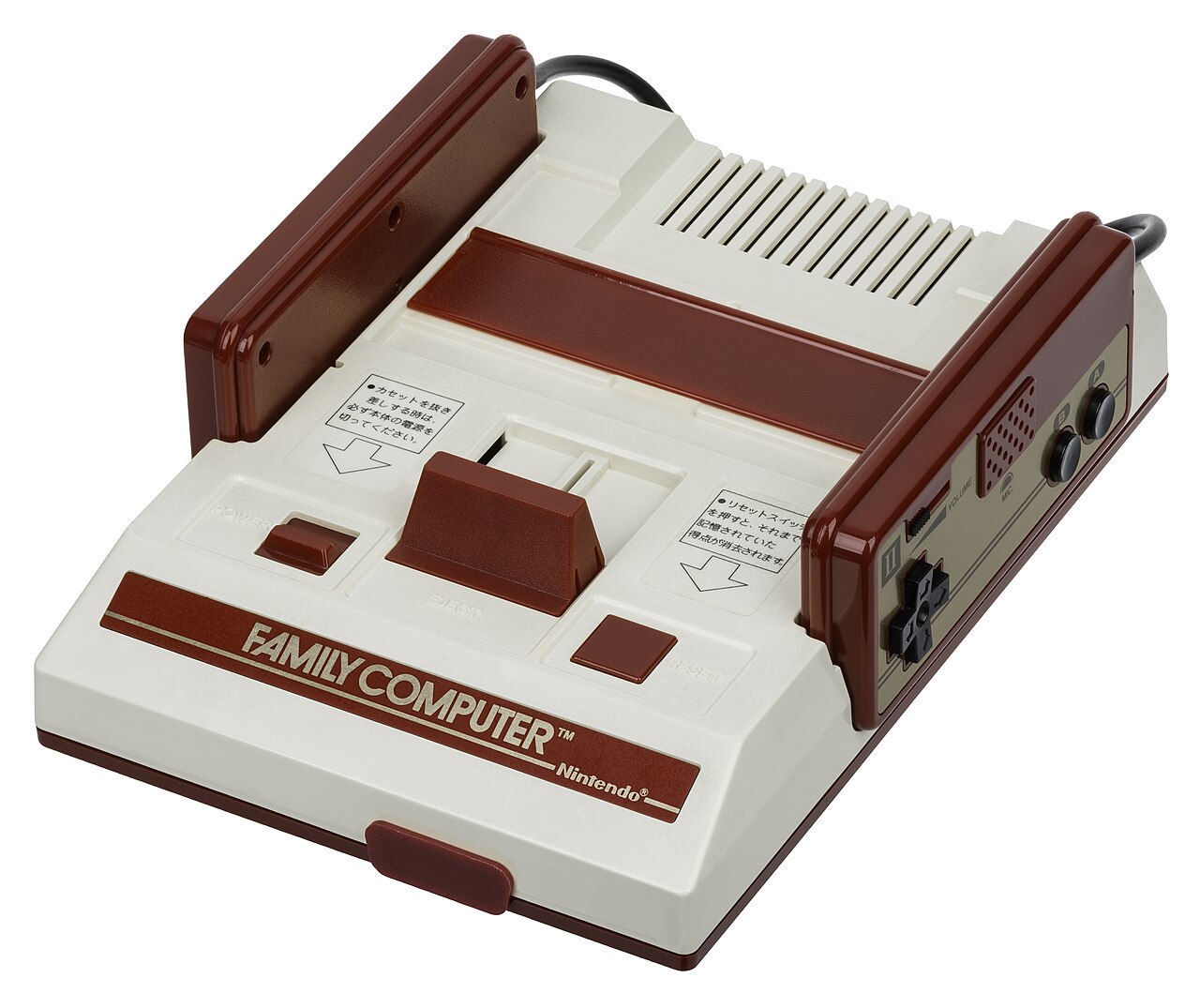
Famicom (Family Computer)
- Manufacturer
- Nintendo
- Production
- 1983–2003
- Generation
- Gen 3
- Type
- Home
- Region
- JP
- Media
- Cartridge
- Units sold
- 19.4M
About Famicom (Family Computer)
The Nintendo Family Computer, commonly shortened to "Famicom," is an 8-bit home video game console released by Nintendo in Japan on July 15, 1983, at a launch price of ¥14,800. A massive commercial success that dominated the Japanese market, it was later redesigned and released internationally as the Nintendo Entertainment System (NES). The Famicom is widely credited with reviving the video game industry after the 1983 crash and establishing the cartridge-based home console template, alongside franchises such as Super Mario Bros. and The Legend of Zelda.
Library & collector facts
1,053licensed games
- Japan: 1,053
Pricing
Launch price (1983)
- 🇯🇵 JPY
- ¥14,800
Launch titles & exclusives
Donkey Kong · Donkey Kong Jr. · Popeye
None (sold as standalone hardware in Japan)
Super Mario Bros. · The Legend of Zelda · Dragon Quest series · Final Fantasy I-III · Mother (EarthBound Beginnings) · Fire Emblem: Shadow Dragon · Famicom Detective Club · Metroid · Kid Icarus · Castlevania
Adventure Island IV (Takahashi Meijin no Bouken Jima IV, 1994) was among the last licensed releases
Family Computer Disk System exclusive titles; sealed early-production launch units with hardwired controllers; gold/silver Famicom Disk System Writer kiosks (institutional collector pieces)
Hardware specs
- Cpu
- Ricoh 2A03 @ 1.79 MHz (customized MOS 6502 with integrated APU)
- Gpu
- Ricoh 2C02 PPU — 25 on-screen colors from a 54-color palette
- Ram
- 2 KB work RAM + 2 KB video RAM
- Sound
- 2A03 APU — 5 channels (2 pulse, 1 triangle, 1 noise, 1 DPCM sample)
Hardware revisions
- Original Famicom HVC-001(1983)
hardwired controllers, RF-only output, early units had a chip bug causing freezes (Nintendo offered free motherboard swaps)
- Sharp Twin Famicom(1986)
licensed integrated unit with built-in Famicom Disk System
- AV Famicom HVC-101(1993)
final cost-reduced redesign with detachable controllers and composite video output
Launch colorways & special editions
- Sharp Twin Famicom (1986, integrated Disk System); Sharp C1 Famicom TV (1983, CRT with Famicom built in); AV Famicom / New Famicom HVC-101 (1993, composite output redesign)
Modding scene
- Difficulty
- soft-mod
- Custom firmware
- N/A (ROM-based)
Reception & legacy
Massive success in Japan — sold out repeatedly through 1984; defined the post-arcade home gaming market in Japan
Early production motherboard bug caused freezes and prompted a costly recall/swap program; strict Nintendo licensing terms (limited cart orders per publisher) bred resentment that later drove publishers to Sega and Sony
Dominant Japanese home console of the 80s; the cultural template for modern console gaming in Japan and the foundation Nintendo's entire business is built on
More from Nintendo
No Famicom (Family Computer) listings yet. List yours or browse similar items.