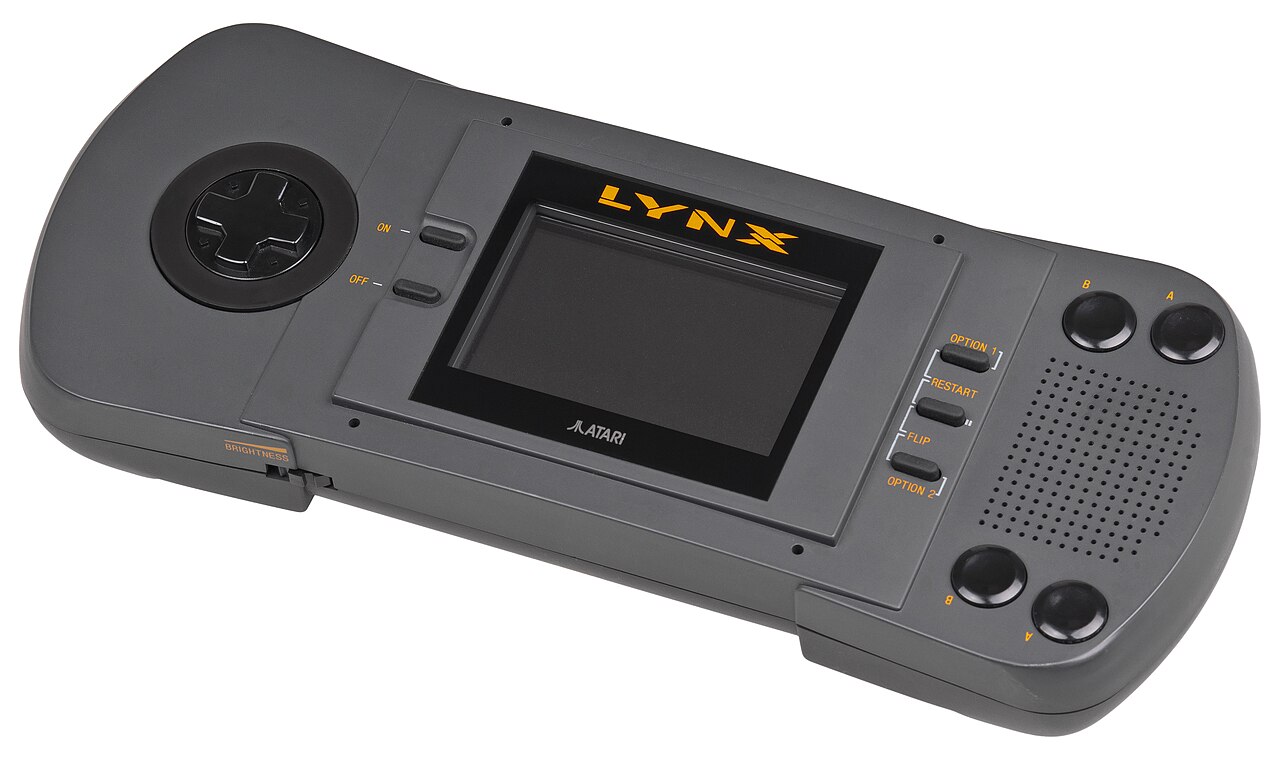
Atari Lynx
- Manufacturer
- Atari
- Production
- 1989–1995
- Generation
- Gen 4
- Type
- Handheld
- Launch price
- $180
- Media
- Cartridge
- Units sold
- 2.0M
About Atari Lynx
The Atari Lynx arrived in September 1989 as the first handheld game console with a colour screen — and it was backlit, which no competitor would manage for years. Two months earlier Nintendo had launched the Game Boy: monochrome, four shades of green, no backlight. On paper it was not close. The Lynx was never really an Atari machine. It was designed at Epyx by Dave Needle and RJ Mical, two engineers who had come off the Amiga, under the project name Handy. Epyx ran out of money before it could ship, and Atari took over production and marketing while Epyx handled software; Epyx was bankrupt by the end of the year. What Atari inherited was a genuinely advanced machine: a 65C02 CPU paired with two custom 16 MHz chips — Mikey for sound, timing and the display, Suzy for graphics and maths — giving it hardware sprite scaling, rotation and distortion a couple of years before the SNES shipped Mode 7, in a device running off six AA batteries. The screen showed 16 colours per scanline from a 4,096-colour palette, the whole thing flipped for left-handed players, and consoles could be chained together over ComLynx cables for multiplayer up to eight. It lost anyway, and the reasons are the most-cited case study in handheld design. The Lynx cost twice a Game Boy, was the size of a paperback, and got four to five hours from six AAs against the Game Boy's thirty from four. Atari's marketing budget was thin and got thinner once the Jaguar became the priority, and third parties never showed up in numbers. Gunpei Yokoi's "lateral thinking with withered technology" beat better hardware decisively. One correction to the received wisdom, because it is repeated wrongly everywhere: the Lynx's battery life was not bad for a colour handheld. Sega's Game Gear, generally remembered as the more successful rival, managed three to four hours against the Lynx I's four to five and the Lynx II's five to six. The Lynx's battery problem was never relative to the Game Gear — it was relative to a monochrome machine that ran for thirty hours, and that comparison was the whole ballgame. The collector consequence is a machine that is fascinating, cheap and fixable. The entire 71-game licensed library runs roughly $1,850 loose at current prices — the most achievable complete library on any fourth-generation platform. Most "broken" Lynxes on the market are a capacitor kit and an afternoon. And a modern IPS screen turns the one component that has aged worst into the best part of the machine.
Library & collector facts
71licensed games
- North America: 71
- Japan: 17
- PAL: 71
What an Atari Lynx costs right now
PriceCharting sold data · Verified 2026-08-07
Lynx I (PAG-0201, 1989)
- Loose
- $189
- Complete in box
- $470
- Sealed / new
- $939
Lynx II (PAG-0401, July 1991)
- Loose
- $179
- Complete in box
- $440
- Sealed / new
- $500
Accessories
| Item | Loose | CIB |
|---|---|---|
| AC adapter (9V DC, center-POSITIVE, 3.5 × 1.3 mm) | $63 | $126 |
| Carrying case (holds console, adapter, cables, cartridges) | $34 | $76 |
| Travel pouch (soft) | $21 | $31 |
| Battery pack | $11 | $17 |
| Sun visor / screen guard | — | $5 |
| Lynx + Batman Returns retailer bundle | — | $291 |
| Lynx GameDrive flashcart (modern) | $105 | — |
Most 'dead' Lynxes aren't dead: the console will not power on at all without a cartridge inserted, which is normal behaviour and explains a real share of "untested, as-is" listings. Loose Lynx I and Lynx II prices are effectively identical, so buy on condition and screen, not model — but sealed Lynx I units run nearly double sealed Lynx IIs, because the 1989 launch box is the scarcer object. Buying to play? A tested loose unit plus a modern 9V DC center-POSITIVE supply beats the 35-year-old brick, which costs more than the difference anyway. Note the polarity: this is the OPPOSITE of the Atari Jaguar's center-negative supply, and Atari collectors own both.
The Lynx's commercial life, from Atari's own annual reports
No per-title Lynx sales figures exist. The Atari Jaguar has an internal sales document that survived, so its per-game numbers are knowable; the Lynx has nothing equivalent, and if you see a site naming a best-seller, that is inference from pack-in status and print runs rather than data — the two most-cited references contradict each other about which title it was.
The CONSOLE story is a different matter, and the received wisdom that "the trail goes cold after 1991" is simply wrong. Atari Corporation was a public company that published annual reports, and the Internet Archive holds the run from 1989 to 1994. They describe the Lynx year by year, in Atari's own words, including the bad years. Every row below is quoted from those reports or from Atari's Form 10-K. We have not found another Lynx resource that uses them.
What they will not give you is a lifetime unit total — Atari never published one. Estimates in circulation run from 500,000 to 3 million, and Wikipedia lists 2 million from a single book. Treat any confident figure with suspicion.
| When | What Atari reported | Source & context |
|---|---|---|
| Sept–Oct 1989 | 50,000 units | Shipped to a limited New York test market; Atari reported selling 90% in the launch month (AP wire) |
| Full-year 1989 | $25.5 million | 1989 Annual Report — Lynx AND the Portfolio handheld computer COMBINED, in their launch year. Not a Lynx-only figure. "In less than four months, six top game titles were released" |
| Q1 1990 | National rollout | 1990 First Quarter Report: "after successful test marketing of Lynx… we began distributing it throughout the United States, and on a worldwide basis" |
| End of 1990 | ~500,000 units | US, Associated Press |
| Full-year 1990 | "sales were slow" | Atari says why, in the 1990 Annual Report: "As a result of the release of only 12 titles during 1990, and the higher launch price, sales of the Lynx were slow." Lynx, Portfolio and TT together were 16.4% of $411.5M net sales |
| January 1991 | Price cut to $99 | Announced at the Consumer Electronics Show — two and a half years before the Lynx II, which is routinely credited with this price |
| Full-year 1991 | Units +80% | 1991 Annual Report: "we reduced the retail price of the Lynx to $99. As anticipated, unit sales increased over 1990 by 80 percent." The 1992 report puts the REVENUE increase at ~50% — the gap between the two is the price cut |
| End of 1991 | 42 titles | Atari counted "forty-two software titles now available" and projected "about 75 titles" for Christmas 1992 — a target the platform never reached; the final licensed library is 71 |
| End of 1992 | ~65 titles | 1992 Annual Report. Sales mix that year had shifted to 34% video games against 21% in 1990 |
| 1993 | $7.5M + $10.6M | Q3 and Q4 inventory write-downs, attributed partly to writing Lynx down "concurrently with the introduction and change in marketing focus to the Company's Jaguar line of products" — the abandonment, dated, in Atari's own words |
| Full-year 1994 | 23% of sales | Lynx, Falcon computers AND other older products COMBINED, against $38.4M net sales — down from 87% in 1993. The Jaguar took 77% in its first full year |
| 31 Dec 1994 | $3.2 million | The ending nobody reports: the carrying value of Lynx inventory Atari BARTERED for advertising credits |
| Early 1995 | over 65 games | Form 10-K: "The Company is currently selling off its remaining inventory." Two more titles shipped in 1995, reaching the final 71 |
| January 1995 | under 7 million | Lynx AND Game Gear COMBINED lifetime, against 16 million Game Boys (Seattle Times; independently repeated by Electronic Games, March 1995) |
- Atari diagnosed its own failure correctly, in public, in 1990: "As a result of the release of only 12 titles during 1990, and the higher launch price, sales of the Lynx were slow." Twelve games in a year, at $179, against a Game Boy with Tetris. It is a sharper post-mortem than most retrospectives manage.
- The price cut worked, and the reports show exactly how well. Unit sales rose 80% in 1991 while revenue rose only about 50% — the shortfall is the price cut itself. Atari moved substantially more hardware for proportionally less money, which is the whole handheld war in one line.
- Atari did support the Lynx — for about two years — which sharpens when the abandonment actually happened. In January 1991 it moved Lynx marketing out of Sunnyvale to a dedicated Atari Entertainment division in Lombard, Illinois, and by mid-1992 that division had EXPANDED into larger premises, adding sales, distribution and merchandising staff. Atari also ran an official CompuServe forum for the platform (type GO LYNX), staffed by two community sysops offering game tips, maps and contests. Set against the 1993 write-downs, the picture is not a console Atari ignored from the start — it is one Atari backed through 1991–92 and then dropped hard the moment the Jaguar arrived.
- Atari bartered the last of the Lynx away. At the end of 1994 it held $3.2 million of prepaid advertising whose value was, in the filing's own words, "the carrying value of Lynx inventory exchanged for advertising credits". The platform did not sell through — it was traded for ad space.
- Release year predicts price today better than quality does, and the annual reports explain why. Averaging loose prices by year across the licensed 71: 1989 titles run about $18, 1991 about $20, 1992 about $19 — then 1993 jumps to $46 and the two 1995 releases average $87. Atari was printing hardest in the years its own reports describe as its push, and had stopped by the years that are now expensive.
- Telegames is the name to watch. It published just 6 of the 71 licensed games — 8% of the library — yet holds three of the six most expensive slots (Double Dragon, Super Off Road, Desert Strike). It took over publishing late, printed small, and those runs are what cost money now.
- Atari gave games away three times, and it still shows in the prices. A mail-in offer running 2 January to 28 June 1991 gave a free cartridge — Electrocop, Chip’s Challenge, Gates of Zendocon or Blue Lightning — with every $149.95 system. In autumn 1992 a second promotion gave away Batman Returns. Then from 1 February to 10 September 1993 came the “Two-Fer”: buy two games at $39.99 or more and claim a free third from Electrocop, Blockout, Gates of Zendocon, Zarlor Mercenary or Robo-Squash. Electrocop and Gates of Zendocon were given away twice.
- Those eight giveaway titles run a median of $16.50 loose today against $20 for the rest of the licensed library, and a mean of $17.25 against $27.29. The effect is real but not absolute — Zarlor Mercenary is the 51st cheapest of 71 — and the sharper way to put it is that none of them is expensive. The priciest giveaway title is $25, in a library that runs to $99.
- A collector footnote hiding in both promotions, and it changes how you read a damaged box. The 1991 offer required you to “cut out the UPC symbol from the box” of the CONSOLE; the 1993 Two-Fer required collecting UPC codes from the GAME boxes. So a Lynx console box, or a boxed Electrocop, Blockout, Gates of Zendocon, Zarlor Mercenary or Robo-Squash, with a UPC panel neatly removed is not damaged goods — it is period evidence that someone redeemed an Atari promotion. Intact-UPC boxes on exactly those titles are correspondingly scarcer than they look.
- Our own console record previously listed 3 million units sold and a 76-game library. Both were wrong, and both have been corrected on this page.
Built from primary sources the usual Lynx write-ups do not use. Atari Corporation's Annual Reports for 1989–1994 and its 1990 quarterly reports, scanned at the Internet Archive; its Form 10-K for the year ended 31 December 1994, filed with the SEC (CIK 0000802019); and Atari's own advertising in Electronic Gaming Monthly issues 21 and 28 (April and November 1991) and GamePro issue 39 (October 1992). Pre-1992 press datapoints and the 71-game count are from the citations in Wikipedia's Atari Lynx article and its List of Atari Lynx games table — Atari Corporation Annual Report 1991
Most 'dead' Lynxes aren't dead — and the screen isn't broken either
Start with the fact that explains a large share of “untested, won’t power on” Lynx listings: THE LYNX WILL NOT POWER ON WITHOUT A CARTRIDGE INSERTED. That is normal, documented behaviour, not a fault — with no cart the power LED lights and the console shuts straight off again, and with a cart only partly seated you get “INSERT GAME” in yellow on screen. A seller with no Lynx games cannot test a Lynx, and a great many of them do not know that. Beyond it, two more things look terminal and usually are not. The first is the power circuit: electrolytic capacitors dry out, the voltage-regulator circuit drifts, and the DC jack’s internal switch contacts wear — any of which produces a console that does nothing when you press power. A full recap kit costs under $10. The second is the screen. Every Lynx you look at will be dim, washed out and low-contrast. That is not damage; the original LCD was mediocre when it was new and three and a half decades of backlight decay have not helped.
What failure looks like
- Power light comes on and immediately goes off — check for a cartridge FIRST. With no cart inserted this is exactly what a healthy Lynx does. With a cart in and properly seated, it points at the power circuit, which is very commonly repairable
- "INSERT GAME" in yellow on screen — the cartridge is only partly seated, or its contacts are dirty. Reseat it a few times and clean the pins with isopropyl alcohol before assuming anything is broken
- No power light at all — capacitors, the voltage-regulator circuit, or a blown transistor in the power section
- Works on batteries but not the adapter, or the reverse — the DC jack has internal switch contacts that disconnect the battery ground when a plug is inserted; when they fail you get exactly one working power source
- Powers on, no sound, dim picture — capacitors
- Console cuts out when the power cord is bumped — worn DC jack, a direct solder-in replacement part
- Dim, washed-out, low-contrast screen — almost certainly NOT a fault. This is what an original Lynx display looks like now
How to test before you buy
- Bring a known-good cartridge, or ask the seller to use one. The console cannot boot without it, so an "untested" Lynx is usually an untestable one rather than a broken one.
- Ask for a photo of it running a game. One photo of a boot screen beats every "untested" listing on the market.
- Test both power sources separately — batteries AND adapter. A unit that works only one way has a bad DC jack: cheap to fix, but you should be paying accordingly.
- Verify the supply is centre-POSITIVE (plus on the tip, minus on the barrel), 3.5 × 1.3 mm. The Lynx tolerates roughly 6–9V DC at up to 1A and draws about 0.6A booting, so a 9V supply is the standard choice. Note this is the OPPOSITE polarity from the Atari Jaguar, which is centre-negative — if you own both, label your bricks.
- Cycle every button including the option keys — the membrane contacts degrade.
- Test the ComLynx port if you care about multiplayer. It is rarely checked and almost never mentioned in listings.
- On a Lynx I, expect the headphone jack to be mono. Stereo is a Lynx II feature, not a repair — but sellers describe it as a fault.
Listing language that usually means "the power circuit has gone"
Budget for two jobs, not one. A full electrolytic recap kit is under $10 in parts, and Console5 sells a voltage-regulator rebuild kit covering the rest of the common failure points — most dead Lynxes are a soldering-iron afternoon from working. The screen is the bigger decision: the McWill IPS LCD replacement is the gold-standard Lynx mod, with BennVenn's kit the other well-regarded option, and both replace the panel entirely with a modern backlit display. Expect roughly $150–$200 in parts and labour, and note that the market pays for it — recapped-and-modded consoles reliably sell for around double an unmodified loose unit. One caution specific to this console: the Lynx power circuit is ground-switched, which is unusual, and measuring against the wrong ground point makes a healthy board read as dead. Use RetroSix's measurement procedure rather than generic advice.
Listing a Lynx on The Game Traders? Photograph it running, on battery power, with the screen clearly legible — then state two more things almost no seller states: whether it has been recapped, and whether the screen is original or modded. Those three facts are the difference between a $180 listing and a $450 one, and "modded" is a material disclosure either way: a buyer who wants an original-condition console and a buyer who wants a player are not the same customer, and mislabelling loses you both.
How selling works →What "complete in box" actually means
The three cartridge shells — and why the mismatch matters
Lynx cartridges went through three physical designs during the console's life, and the shell is the easiest thing to check in a listing photograph. Wikipedia records the sequence; the profiles below are schematic drawings, not photographs, showing the feature that distinguishes each generation.
Flat
1989 — first generation
A plain slab, designed to stack for storage. They stack beautifully and are miserable to get back out of the console, which is why they were replaced within about a year. Launch titles were made in this shell, and variant collectors pay real premiums for first-run flat copies that generalist price guides do not track separately.
Ridged / tabbed
Second generation
Adds two small tabs on the underside to grip when pulling the cartridge out. Fixes extraction, breaks stacking — flat carts will sit on top of these, but these will not sit on each other.
Curved lip
Third generation — the final standard
A curved lip along the top edge to pull against. This became the standard, and every official title was released or re-released in it, which is why a curved-lip cart alone tells you nothing about a game's age.
- A 1989 launch title in a big box should have a FLAT cartridge. A curved-lip cart inside 1989 packaging is a later re-release, or an assembled pairing — not necessarily fraud, but not the original product, and it should not carry a first-run premium.
- Because every title exists in the curved-lip shell, that shell is never evidence of anything. Only a flat or tabbed cart is a dating signal.
- Shell style is one of the few checks that works from a seller's existing photographs, so ask for a straight-on shot of the cartridge top edge before you ask for anything else.
- This is how 71 games generate 120+ catalogued variants, alongside "no stripe" label variants, blister packs, big boxes, and the 17 Japanese releases.
The retail box contained
- Console
- California Games pack-in cartridge (most bundles)
- AC power adapter (9V DC, center-positive)
- ComLynx cable
- Carrying pouch
- Console manual and inserts
- Cardboard tray and inner packaging
- Outer box
The $99 price point is older than the Lynx II and is routinely misattributed to it. Atari had already cut the ORIGINAL Lynx to $99.95 for a bare console by April 1991 — three months before the Lynx II shipped — alongside a $149.95 pack-out with California Games, the ComLynx cable and the AC adapter. The Lynx II inherited both configurations, and listings blur them constantly: a bare console with no accessories, and a boxed "Deluxe Package" with the adapter, pouch and a pack-in. Both are legitimately a Lynx II, but only one is a CIB candidate — a "Lynx II CIB" with no adapter and no pouch is a box with a console in it. Separately, the original AC adapter is now a genuinely expensive item on its own (around $63 loose, $126 boxed), which is worth knowing before you treat a missing brick as a minor deduction.
Grading shorthand
- Complete
- Console, box, tray, manual, adapter, ComLynx cable, pouch, pack-in cartridge
- Console complete
- Everything but the pack-in game
- Loose
- Console and a working power source, screen legible, polarity verified
- Parts
- No power on either source, or a non-functional screen with known-good power
The complete library — all 71 licensed games, plus what came after
prices PriceCharting · Verified 2026-08-07
The licensed library (71) — official Atari cartridges, 1989–1995
| Game | Loose | CIB | Sealed | Availability | Fake risk |
|---|---|---|---|---|---|
| Super Asteroids & Missile Command1995 | $99 | $183 | $235 | Atari 50 + Evercade | Med |
| Double Dragon1993 | $97 | $154 | $249 | Cartridge only | Med |
| Lemmings1993 | $95 | $263 | $660 | Cartridge only | Med |
| Battlezone 20001995 | $75 | $99 | $106 | Cartridge only | Med |
| Super Off Road1993 | $75 | $165 | $223 | Cartridge only | Low |
| Desert Strike1993 | $62 | $150 | $275 | Cartridge only | Low |
| Xenophobe1990 | $48 | $72 | $110 | Cartridge only | Low |
| Ninja Gaiden III: The Ancient Ship of Doom1993 | $42 | $65 | $73 | Cartridge only | Low |
| BattleWheels1993 | $40 | $88 | $176 | Cartridge only | Low |
| Ninja Gaiden1991 | $38 | $93 | $144 | Cartridge only | Low |
| Pac-Land1991 | $35 | $47 | $93 | Cartridge only | Low |
| Joust1992 | $33 | $40 | $59 | Cartridge only | Low |
| Qix1991 | $32 | $42 | $85 | Cartridge only | Low |
| European Soccer Challenge1993 | $31 | $117 | $235 | Cartridge only | Low |
| Gauntlet: The Third Encounter1990 | $31 | $39 | $54 | Cartridge only | Low |
| Rampage1990 | $30 | $58 | $75 | Cartridge only | Low |
| Ms. Pac-Man1990 | $28 | $45 | $99 | Cartridge only | Low |
| RoadBlasters1990 | $27 | $38 | $52 | Cartridge only | Low |
| Rygar1990 | $27 | $34 | $41 | Cartridge only | Low |
| Dinolympics1992 | $26 | $30 | $40 | Cartridge only | Low |
| Awesome Golf1991 | $25 | $30 | $45 | Evercade | Low |
| Zarlor Mercenary1990 | $25 | $42 | $85 | Evercade + PC | Low |
| Baseball Heroes1992 | $24 | $30 | $60 | Cartridge only | Low |
| Lynx Casino1992 | $24 | $47 | $95 | Cartridge only | Low |
| Toki1992 | $24 | $36 | $35 | Cartridge only | Low |
| Warbirds1991 | $24 | $37 | $71 | Atari 50 | Low |
| Pinball Jam1992 | $23 | $24 | $33 | Cartridge only | Low |
| S.T.U.N. Runner1991 | $23 | $32 | $35 | Cartridge only | Low |
| Scrapyard Dog1991 | $22 | $50 | $100 | Atari 50 + Evercade | Low |
| World Class Fussball/Soccer1992 | $22 | $93 | $187 | Cartridge only | Low |
| Blue Lightning1989 | $21 | $50 | $87 | Evercade + PC | Low |
| Chip's Challenge1989 | $21 | $25 | $50 | Evercade + PC | Low |
| Dracula the Undead1991 | $21 | $30 | $36 | Evercade | Low |
| Shadow of the Beast1992 | $21 | $35 | $37 | Cartridge only | Low |
| Checkered Flag1991 | $20 | $42 | $84 | Evercade + PC | Low |
| Hockey1992 | $20 | $30 | $43 | Cartridge only | Low |
| Klax1990 | $20 | $23 | $40 | Cartridge only | Low |
| Paperboy1990 | $20 | $25 | $30 | Cartridge only | Low |
| The Fidelity Ultimate Chess Challenge1991 | $19 | $32 | $43 | Cartridge only | Low |
| Robotron: 20841991 | $19 | $37 | $40 | Cartridge only | Low |
| A.P.B.1991 | $18 | $27 | $31 | Cartridge only | Low |
| Hard Drivin'1991 | $18 | $73 | $88 | Cartridge only | Low |
| Pit-Fighter1992 | $18 | $20 | $24 | Cartridge only | Low |
| Rampart1992 | $18 | $38 | $23 | Cartridge only | Low |
| Todd's Adventures in Slime World1990 | $18 | $36 | $73 | Evercade + PC | Low |
| Batman Returns1992 | $17 | $50 | $71 | Cartridge only | Low |
| Power Factor1993 | $17 | $17 | $26 | Evercade | Low |
| Gates of Zendocon1989 | $16 | $25 | $25 | Evercade + PC | Low |
| Hydra1992 | $16 | $21 | $25 | Cartridge only | Low |
| Viking Child1991 | $16 | $24 | $30 | Cartridge only | Low |
| Basketbrawl1992 | $15 | $27 | $24 | Atari 50 + Evercade | Low |
| California Games1989 | $15 | $50 | $281 | Evercade + PC | Low |
| Dirty Larry: Renegade Cop1992 | $15 | $20 | $25 | Cartridge only | Low |
| Electrocop1989 | $15 | $26 | $49 | Evercade + PC | Low |
| Gordo 1061993 | $15 | $30 | $35 | Evercade | Low |
| Shanghai1990 | $15 | $16 | $17 | Cartridge only | Low |
| Steel Talons1992 | $15 | $18 | $19 | Cartridge only | Low |
| Switchblade II1992 | $15 | $33 | $38 | Cartridge only | Low |
| Bill & Ted's Excellent Adventure1991 | $14 | $28 | $32 | Cartridge only | Low |
| Jimmy Connors' Tennis1993 | $14 | $19 | $18 | Evercade | Low |
| NFL Football1992 | $14 | $25 | $42 | Cartridge only | Low |
| Blockout1991 | $13 | $29 | $39 | Cartridge only | Low |
| Malibu Bikini Volleyball1993 | $13 | $25 | $21 | Atari 50 + Evercade | Low |
| Turbo Sub1991 | $13 | $26 | $30 | Atari 50 | Low |
| Crystal Mines II1992 | $12 | $19 | $37 | Cartridge only | Low |
| Kung Food1992 | $11 | $14 | $15 | Cartridge only | Low |
| Super Skweek1991 | $11 | $15 | $17 | Evercade | Low |
| Xybots1991 | $11 | $23 | $25 | Cartridge only | Low |
| Ishido: The Way of Stones1991 | $10 | $15 | $19 | Evercade | Low |
| Robo-Squash1990 | $10 | $17 | $20 | Cartridge only | Low |
| Tournament Cyberball1991 | $10 | $14 | $12 | Cartridge only | Low |
Post-discontinuation Telegames releases (3) — the expensive end
| Game | Loose | CIB | Sealed | Availability | Fake risk |
|---|---|---|---|---|---|
| Fat Bobby1997 | $125 | $126 | $251 | Cartridge only | Med |
| Raiden1997 | $113 | $262 | $525 | Cartridge only | Med |
| Hyperdrome1999 | $32 | $70 | $140 | Cartridge only | Low |
Atari-era unlicensed cartridges — including the disputed "72nd game"
| Game | Loose | CIB | Sealed | Availability | Fake risk |
|---|---|---|---|---|---|
| Bubble Trouble1994 | $135 | $135 | $270 | Cartridge only | Med |
| Krazy Ace Miniature Golf1993 | $45 | $100 | $51 | Cartridge only | Med |
Prototypes & post-commercial homebrew — several still sold new
| Game | Loose | CIB | Sealed | Availability | Fake risk |
|---|---|---|---|---|---|
| Relief Pitcher (prototype release)2011 | $340 | $748 | $1,497 | Cartridge only | High |
| Zaku2009 | $126 | $240 | $392 | Cartridge only | Med |
| PokerMania2003 | $109 | — | — | Cartridge only | Med |
| QuadroMania2017 | $70 | — | — | Cartridge only | Low |
| Solitaire!2009 | $68 | — | — | Cartridge only | Low |
| SokoMania1999 | $66 | — | — | Cartridge only | Low |
| Poker2010 | $60 | — | — | Cartridge only | Low |
| Wyvern Tales2018 | $59 | $68 | $63 | Cartridge only | Low |
| Alpine Games2004 | $54 | $62 | $70 | Cartridge only | Low |
| S.I.M.I.S.1998 | $53 | $116 | $60 | Cartridge only | Med |
| Crystal Mines II: Buried Treasure1999 | $50 | $60 | $60 | Evercade | Low |
| T-Tris1996 | $44 | $100 | $63 | Cartridge only | Med |
| Hot Dog2011 | $43 | — | $50 | Cartridge only | Low |
| Lexis1999 | $39 | $50 | $60 | Cartridge only | Low |
| SFX: The Ultimate Audio Tool1998 | $39 | — | $45 | Cartridge only | Low |
| Championship Rally2000 | $32 | $51 | $60 | Cartridge only | Low |
| Remnant: Planar Wars 3D2000 | $24 | $52 | $60 | Evercade | Low |
| Ponx1999 | $24 | $38 | $45 | Cartridge only | Low |
| Centipede2003 | — | $30 | $60 | Cartridge only | Med |
| Lynx Othello1999 | — | $24 | $33 | Cartridge only | Low |
Authenticity: on the Lynx, the risk is the box
The Jaguar has a well-documented reproduction-cartridge problem. The Lynx does not, and repeating that warning here would be lazy. With an average loose game around $26 and only three titles above $75, there is very little on this platform worth counterfeiting — and no documented Lynx repro epidemic exists. That is our reading of our own price data rather than a sourced finding, so treat it as an argument, not a citation. But the Lynx's real authenticity risk is somewhere else entirely, and it is more concentrated than the usual telling suggests. Across the 71 licensed games the median complete-in-box copy is worth 1.6 times its loose cartridge — real, but not dramatic. The money sits in a minority: 21 titles clear a 2× multiple, four clear 3×, and World Class Fussball/Soccer and Hard Drivin' both top 4×. Sealed is where it gets wild — a median of 2.3× and a maximum of 18.7× on California Games. Add an empty console box shell trading openly, and the shape of the fraud is obvious: on the specific titles below, a common cartridge plus a convincing reprinted box and manual is worth several times the cartridge alone.
| Title | Loose cart | Complete in box | What the paper is worth |
|---|---|---|---|
| Lemmings | $95 | $263 | +$168 |
| Super Off Road | $75 | $165 | +$90 |
| European Soccer Challenge | $31 | $117 | +$86 |
| World Class Fussball/Soccer | $22 | $93 | +$71 |
| Hard Drivin' | $18 | $73 | +$55 |
| Ninja Gaiden | $38 | $93 | +$55 |
What actually distinguishes them
- Inspect the cardboard, not the PCB
- This is the inversion. Originals are offset-printed with consistent ink density and sharp edges; reprints show a halftone dot pattern under 10× magnification. Check the smallest text on the box — the legal line and the barcode are where reprints fall apart, and a phone macro shot is usually enough.
- Box wear that does not match the cart
- A pristine box around a scuffed, label-yellowed cartridge is the classic assembled-CIB signature. Age should be consistent across every component. This is the single most reliable tell on the platform.
- Shell style against release year
- Lynx cartridges went through three physical designs — flat (1989, stackable and miserable to extract), ridged/tabbed, then the curved lip that became the final standard and that every title was released or re-released in. A 1989 launch title in a big box should have a flat first-generation cart, not a late-run curved-lip one. A mismatch is not automatically fraud, but it is not the original product either, and it should not carry a first-run premium.
- Inserts, not just the manual
- Registration cards, catalogue inserts and poster inserts are what genuinely complete copies have and assembled ones do not. They are also what honest sellers photograph without being asked.
- Sealed, very carefully
- Sealed copies carry the largest multiples on the platform — California Games at roughly 19× its loose price, Lemmings at 7× — and Lynx shrink-wrap is unremarkable, resealable film. At those prices, get third-party grading or do not buy.
- The console box is cheap to fake too
- Empty Lynx box shells sell openly, so assembling a "CIB console" from parts costs very little. Ask for the tray, the inserts and the manual in one photograph, not the outer box on its own.
The genuinely expensive mistake on this platform is not a counterfeit at all — it is paying secondary-market rarity prices for a homebrew cartridge the developer is still selling new. Songbird Productions and others have been shipping boxed Lynx games continuously since the late 1990s, and the scene is still producing them. Check whether it is in print before you bid.
ComLynx — which games actually support link play, and with how many players
The Lynx shipped with a serial networking system years ahead of its competition, and one design decision that killed it commercially. It began as an infrared link codenamed RedEye, abandoned before release for a straightforward reason: people kept walking through the beam. The shipping version is a cable that daisy-chains consoles indefinitely — internally two wires, and one of the easiest DIY cables in retro gaming.
The numbers get conflated everywhere, and the reason is that ATARI ITSELF published two different ones. Its consumer advertising said “you can connect up to 8 Lynxes”; its 1989 and 1991 annual reports promised up to 16 networked players. Neither was ever matched by a released game. Here are the figures that actually mean something. Eighteen is the ELECTRICAL limit: the Lynx's serial drivers cannot reliably pull up more than 17 other units. Eight is the practical limit: the most players any game actually supports. And the rule that killed it — every player needs their own copy of the cartridge. There is no host-and-join mode. In 1991 a four-player session meant four consoles, four copies, three cables and four sets of batteries; roughly $800 of hardware for an afternoon. The technology worked perfectly. The economics were impossible.
The table below separates real linked multiplayer from games that simply let two people share one console — a distinction most published Lynx lists quietly collapse, which is how you end up seeing Qix and Pac-Land described as ComLynx titles.
- Maximum units chained
- 18
- Maximum players in any game
- 8
- What Atari claimed
- 8 or 16
- Cartridges required
- One per player
- Cable
- Two wires
Electrical limit — the Lynx's serial drivers cannot reliably pull up more than 17 others
Only Todd's Adventures in Slime World goes this high
Atari contradicted itself: its consumer ads said “connect up to 8 Lynxes”, its 1989 and 1991 Annual Reports promised 16 networked players
No host-and-join mode — this is the rule that sank ComLynx commercially
Male + male at one end, male + female at the other, so units daisy-chain
6 players(1)
4 players(10)
The sweet spot — and still four consoles and four cartridges.
2 players(15)
Two consoles, two cartridges, one cable — the realistic way most people play linked Lynx today.
Same console, alternating turns — NOT ComLynx(4)
Multiplayer, but you pass the handheld. No cable, no second console, no second cartridge. Published lists routinely file these as ComLynx titles; they are not.
Reported but unconfirmed(8)
Later releases the authoritative period source doesn't cover. Listed as claims, not facts.
- BattleWheels(reported 6 players — designed around linked play, but absent from the period FAQ list)
- Battlezone 2000(reported 4 players)
- European Soccer Challenge(reported 2 players)
- Hockey(reported 2 players)
- NFL Football(reported 2 players)
- Raiden(reported 2 players — the 1997 Telegames Lynx release)
- Hyperdrome(reported 4 players — 1999, long after the FAQ)
- T-Tris(reported 8 players — homebrew)
- Budget for cartridges, not just consoles. A four-player Warbirds night needs four copies of Warbirds. Buying four loose commons is cheap; this is still the thing first-time Lynx buyers most often fail to plan for.
- Test the ComLynx port before you buy. It is almost never checked and almost never mentioned in listings, and a console that plays fine solo can have a dead serial port.
- The cable is two wires and trivially DIY-able, which matters because original ComLynx cables are now harder to find than the consoles.
- All linked units have to be powered on within a few seconds of each other, or the chain will not establish.
- One piece of trivia stated wrongly everywhere: the Atari Jaguar carries a ComLynx signal on its system bus, but it has no ComLynx port, and no adapter to let a Jaguar play Lynx games was ever planned. Jaguar-to-Lynx cross-system play was only ever theoretical.
- If you see a Vindicators cartridge listed, know what it is not. Atari advertised Vindicators as “coming soon” for the Lynx in its own 1991 magazine ads, alongside Zarlor Mercenary, Rampage and Xenophobe — the other three shipped and it did not. It appears in no licensed library list, and any cartridge in circulation is a prototype or later homebrew production rather than a released Atari game.
Per-title player counts and the 18-unit driver limit from the period Atari Lynx FAQ hosted at AtariArchives, cross-checked against modern community lists where they exist — Lynx FAQ — AtariArchives
Buying guide by budget
A tested loose Lynx II and a modern 9V center-positive supply. Add Chip's Challenge, Gates of Zendocon, Ishido, Klax and Robotron: 2084 for under $80 the lot. Accept that the screen will be dim.
A recapped console with a McWill or BennVenn IPS screen. This is the highest-value purchase on the platform and it changes the machine completely — buy one already done by someone competent, or budget $150–$200 for parts and a technician. Add Blue Lightning, S.T.U.N. Runner, Warbirds and Todd's Adventures in Slime World: the platform's actual case for itself.
A complete Lynx I or a Lynx II Deluxe Package with a clean box, plus the mid-tier games where the box is the point — Hard Drivin', California Games, Batman Returns, Blue Lightning. At this tier print-quality inspection matters more than condition grading. Do not mod a boxed unit: a CIB Lynx I is worth far more intact than as a modded loose console with a spare box.
All 71 official games, at roughly $1,850 in current guide value. No other fourth-generation console comes close to being completable — budget 12–18 months of patient buying, and note that the four most expensive titles are about a fifth of the total on their own.
A sealed Lynx I (around $939, with graded examples clearing far more), sealed Lemmings, the Relief Pitcher prototype, and boxed Telegames Raiden. At this level authentication outranks condition — get grading, and remember that on this platform the packaging IS the asset.
Frequently asked questions
How much is an Atari Lynx worth in 2026?
A loose Lynx I runs about $189 and a Lynx II about $179 — effectively identical, so buy on condition. Complete in box, the Lynx I is around $470 and the Lynx II around $440. Sealed, the gap widens sharply: roughly $939 for a Lynx I against $500 for a Lynx II. A console with a modern IPS screen mod and a recap regularly sells for around double an unmodified loose unit. All figures are PriceCharting sold data.
How many games does the Atari Lynx have?
Seventy-one official releases between 1989 and 1995 — the collector standard, and the count Wikipedia's own games list arrives at. Beyond those there are three post-discontinuation Telegames retail titles, two Atari-era unlicensed cartridges, and roughly 60 homebrew games that are still being produced today. You will see 73, 76, 100+ and 120+ quoted elsewhere; those add post-Atari releases, disputed titles, modern homebrew, or cartridge variants rather than distinct games.
What was the best-selling Atari Lynx game?
Nobody knows. Unlike the Atari Jaguar, where an internal sales document survived, no per-title Lynx sales figures exist from any source. California Games was the pack-in for most bundles and RoadBlasters is named by some references, but both claims are inference rather than data, and reference sources contradict each other. Anyone stating a figure with confidence is guessing.
Why won't my Atari Lynx turn on?
First, the thing most people miss: the Lynx will not power on at all without a cartridge inserted. That is normal — with no cart the power light comes on and goes straight back off. Check that before anything else, and clean the cartridge contacts while you are there. If it still will not start, it is almost always the power circuit, and almost always repairable. Failed electrolytic capacitors are the most common cause and a full recap kit costs under $10. Also check the DC jack — its internal switch contacts fail, producing a console that works on batteries but not the adapter, or the reverse. Verify your supply is 9V DC, center-POSITIVE, 3.5 × 1.3 mm; note this is the opposite polarity from the Atari Jaguar.
Is the Atari Lynx screen supposed to look that bad?
Largely, yes. The original LCD was unimpressive when new and three and a half decades of backlight decay have made it worse. This is not damage and cleaning will not fix it. The McWill or BennVenn IPS replacement is the standard solution and transforms the machine — but it also disqualifies the console from original-condition collecting, so decide which hobby you are in before you buy.
Was the Atari Lynx really more powerful than the Game Boy?
Comprehensively. Colour, backlit, a 4,096-colour palette with 16 colours per scanline, hardware sprite scaling and rotation, 16 MHz co-processors, and networked multiplayer — years before the SNES shipped Mode 7. It lost anyway, but the usual explanation (twice the price of a Game Boy) is only true of 1989. By April 1991 Atari was advertising the Lynx at $99.95 against the Game Boy at $89.95 — a $10 gap — with the Game Gear at $159.95 and the TurboExpress at $299.95. Price stopped being the problem; battery life and the library did not. Six AAs bought four to five hours on a Lynx I and five to six on a Lynx II; a Game Boy ran about thirty on four.
Do I need a separate copy of each game for ComLynx multiplayer?
Yes, every time. Each linked console needs its own cartridge — there is no host-and-join mode. In 1991 a four-player session meant four consoles, four copies, three cables and four sets of batteries, roughly $800 of hardware for an afternoon; that economics, not the technology, is why ComLynx never sold consoles. Today a second Lynx is under $200 and a second copy of most games is $15–25, but it is still the thing first-time buyers most often fail to budget for.
What happened to the unsold Atari Lynx stock?
Atari traded it for advertising. Its Form 10-K for 1994 records $3.2 million of prepaid advertising on the balance sheet whose value equals, in the filing's own words, "the carrying value of Lynx inventory exchanged for advertising credits". The same filing has Atari "currently selling off its remaining inventory" of Lynx hardware while the Jaguar took 77% of net sales. The Lynx did not sell through — its last stock was swapped for ad space.
Why aren't the best Atari Lynx games on Atari 50?
Because Atari does not own them. Not one of the six Lynx titles on Atari 50 was developed by Epyx — and Epyx made most of the platform's classics. Every Epyx-developed Lynx game with a modern release instead appears on Evercade and on PC as The Epyx Collection: Handheld: Blue Lightning, California Games, Chip's Challenge, Electrocop, Gates of Zendocon, Todd's Adventures in Slime World and Zarlor Mercenary. The rights split cleanly, and you can read it straight off the two line-ups.
Which Atari Lynx games will probably never be re-released?
The ones with two rights holders stacked on top of each other. Gauntlet: The Third Encounter and Xenophobe are the only Epyx-developed Lynx games missing from BOTH Atari 50 and the Epyx collections — and both are conversions of arcade games Epyx did not own either. Beyond those, borrowed IP is the pattern, and the copyright lines in Atari’s own Lynx advertising spell it out: Klax and Vindicators are Atari GAMES Corporation marks, Gauntlet is Atari Games via Tengen, Xenophobe belongs to Bally/Midway. Atari Games — the arcade company — had been a separate business from Tramiel’s Atari Corporation since 1984, so much of the Lynx’s arcade library was licensed in rather than owned. 50 of the 71 have no modern release at all, and the list is dominated by arcade conversions and licensed tie-ins whose owners are someone else entirely — Ms. Pac-Man, Rygar, Toki, Klax, Joust, Robotron: 2084, Batman Returns, Bill & Ted's Excellent Adventure. The games Atari can freely reissue are largely the ones it originated.
How many Atari Lynxes can you connect together with ComLynx?
Two numbers, and they get conflated everywhere. Eighteen is the electrical limit — the Lynx's serial drivers cannot reliably pull up more than 17 other units. Eight is the practical limit, because that is the most players any game supports, and only Todd's Adventures in Slime World goes that high. Checkered Flag reaches six; ten titles support four. Every linked player needs their own cartridge.
Which Atari Lynx games support ComLynx multiplayer?
Twenty-seven of the 71 licensed games support genuine link-cable play, per the period Lynx FAQ. Be careful with published lists: several fold in games whose "two-player" mode is just passing one console back and forth — Qix, Pac-Land, Ishido and The Fidelity Ultimate Chess Challenge are all commonly miscategorised this way. Our ComLynx section separates the two and flags the later titles the FAQ predates.
What's the difference between a Lynx I and a Lynx II?
The Lynx II arrived in July 1991: smaller and lighter, with rubber hand grips, a clearer backlit screen with a power-save mode that switches the backlight off, better battery life, and a stereo-wired headphone jack — the Lynx I's is mono. On price the two get mixed up constantly: the $99 bare-console configuration was already in place for the Lynx I by April 1991, three months before the Lynx II shipped, so the Lynx II inherited that price rather than introducing it. For playing, the Lynx II is the better machine. For collecting, sealed Lynx I units are worth substantially more.
Why do Atari Lynx games have loading screens?
Because the hardware works differently from every other cartridge console. Lynx game data is copied from the cartridge into the console's 64 KB of RAM by a small bootstrap ROM before it can run, rather than executing directly from the cartridge. That is why a Lynx game takes noticeably longer to start than a Game Boy or Game Gear game, and why less RAM is left for the game once it is running. It is a design characteristic inherited from the original Epyx Handy prototype, not a fault.
Are Atari Lynx games commonly faked?
Cartridges, rarely — the library is too cheap to be worth counterfeiting, at an average of about $26 loose. Boxes and manuals are the real risk, but on a minority of titles rather than across the board: the median complete-in-box copy is worth 1.6 times its loose cartridge, while 21 of the 71 clear 2× and a few reach 4×. Sealed copies go further still, up to 18.7× on California Games. On those titles, reprinted packaging and assembled "CIB" listings are the thing to watch for — inspect print quality on the box and manual rather than the cartridge board.
Lineage
Release timeline
- 🇺🇸 North America
- September 1, 1989
- Lifespan
- 6 years on market
Pricing
Launch price (1989)
- 🇺🇸 USD
- $180
Launch titles & exclusives
California Games · Blue Lightning · Electrocop · Gates of Zendocon · Chip's Challenge
California Games (most bundles)
Blue Lightning · S.T.U.N. Runner · Warbirds · Robotron: 2084 (widely considered the best contemporary port) · Todd's Adventures in Slime World · BattleWheels · Gates of Zendocon · Zarlor Mercenary · Chip's Challenge (the original release — every later version descends from it)
Battlezone 2000 and Super Asteroids & Missile Command (1995) were the last games Atari itself published. Telegames continued after discontinuation with Raiden and Fat Bobby (1997) and Hyperdrome (1999) — the final commercial Lynx release
Sealed Lynx I console (the platform's most valuable object); the Relief Pitcher prototype cartridge; Telegames Raiden (1997) — the most valuable normally-distributed Lynx game; sealed Lemmings; and the Marlboro Atari Lynx, a red German promotional console for which no public sale has ever been recorded at any price
Hardware specs
- Cpu
- "Mikey" — VLSI VL65NC02 8-bit CPU (65C02-based, up to 4 MHz, ~3.6 MHz average) with integrated sound engine, LCD driver, eight system timers and UART, on a 16 MHz custom CMOS chip
- Gpu
- "Suzy" — 16-bit custom CMOS at 16 MHz. Unlimited blitter sprites with collision detection, hardware sprite scaling/distortion/tilting, hardware sprite decompression, and a maths engine
- Ram
- 64 KB 120ns DRAM
- Ports
- ComLynx serial (daisy-chained multiplayer, eight players maximum stable), 3.5 mm headphone
- Power
- 6 × AA (4–5 hours on Lynx I, 5–6 on Lynx II). External: 9V DC, centre-POSITIVE, 3.5 × 1.3 mm — the opposite polarity to the Atari Jaguar
- Sound
- 4 channels, 8-bit DAC or PSG. Headphone jack wired for mono on the Lynx I, stereo on the Lynx II
- Weight
- ~500 g (with batteries)
- Dimensions
- 273 × 38 × 108 mm
- Media Formats
- Cartridges of 128, 256 and 512 KB; 1 MB with bank-switching
- Display Output
- Backlit 3.5" colour LCD, 160 × 102 (16,320 pixels), 4,096-colour palette, 16 colours per scanline, variable frame rate up to 75 fps
Hardware revisions
- Lynx I(1989)
Original launch hardware (model PAG-0201). Larger form factor, backlit colour LCD, headphone jack wired for mono, 4–5 hours from six AA batteries. Launched at about $180 with accessories.
⚠ The defining failure is the power circuit — dried electrolytic capacitors, drifting voltage-regulator components, and worn DC-jack switch contacts that leave the console working on only one power source. Most are repairable for under $10 in parts.
- Lynx II(1991)
July 1991 redesign (model PAG-0401). Smaller and lighter, rubber hand grips, clearer backlit screen with a power-save mode that switches the backlight off, 5–6 hours of battery life, and a stereo-wired headphone jack. Sold bare at $99, or as a boxed "Deluxe Package" with adapter, pouch and a pack-in.
⚠ Same power-circuit failure modes as the Lynx I. Both models share the dim, low-contrast original LCD, which is age and design rather than damage.
Launch colorways & special editions
- None official. Retailer bundles existed, notably a Batman Returns package
- Marlboro Atari Lynx — a red promotional console branded "Marlboro Abenteuer Team", produced for the German market alongside the unreleased game Marlboro Go! and redeemable with cigarette-pack points. Never widely distributed
Modding scene
- Difficulty
- hard-mod
- Custom firmware
- N/A (ROM-based); flashcarts: Lynx GameDrive, ElCheapoSD
Reception & legacy
Praised for color screen and horsepower advantage over Game Boy at launch; criticized heavily for battery life and bulk
Designed at Epyx and sold to Atari mid-development; Epyx went bankrupt within the year. Marketing was cut once Atari prioritised the Jaguar, and third-party support never materialised. Unlike the Jaguar — whose rights Hasbro explicitly released in 1999 — Atari's rights to the Lynx platform were never clearly released to the public domain, leaving the homebrew scene on murkier legal ground.
First handheld game console with a backlit colour LCD, and the first with hardware sprite scaling and rotation. Atari was honoured at the 59th Annual Technology & Engineering Emmy Awards in 2008 for pioneering handheld gaming with the Lynx. Its defeat by the Game Boy is the canonical demonstration of Gunpei Yokoi's "lateral thinking with withered technology" — and the reason every handheld since has led with battery life.
References
More from Atari
No Atari Lynx listings yet. List yours or browse similar items.
Atari Lynx in the news
Recent coverage mentioning the Atari Lynx, gathered from 80+ gaming-news sources.